

Blog
What Is Shore A Hardness? A Footwear Manufacturer’s Guide to Measuring Rubber and TPR

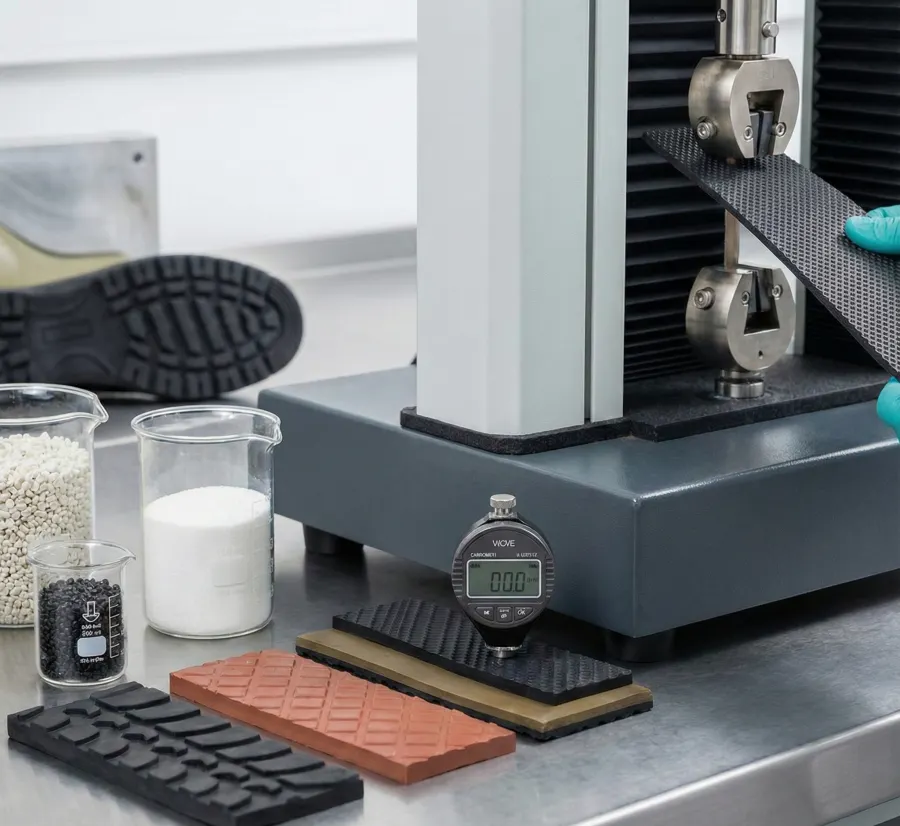
Shore A hardness appears on the specification sheet of every rubber and TPR soling product you’ve ever ordered. It is the single most-referenced measurement in outsole procurement — and yet most buyers order by Shore A values without fully understanding what the scale measures, what the numbers mean in practice for a finished shoe, or why applying Shore A to EVA foam produces unreliable specification data.This guide closes that gap. By the end, you’ll understand what Shore A actually measures, where it sits in the family of hardness scales, how to read the 0–100 range in footwear terms, why rubber and TPR behave differently at the same Shore A value, and critically — why EVA foam requires a different scale entirely (Asker C). Whether you’re writing a sole specification from scratch or auditing an existing supplier’s data quality, this is the reference that makes every other hardness conversation more precise. Weston’s rubber soling materials and TPR sole range are all specified in Shore A with in-house testing — this guide explains why that matters.
What Is Shore A Hardness? Definition and What It Actually Measures
Shore A hardness measures a material’s resistance to permanent indentation by a standardised indenter under a defined spring load. A device called a Shore durometer applies a force through a truncated cone-shaped indenter (flat-tipped) onto the material surface. The depth of penetration after a standard dwell time — typically 15 seconds as defined by ASTM D2240 and ISO 868 — is converted to a reading on a 0–100 scale.
The scale works like this: 0 Shore A means the indenter sinks completely into the material — zero resistance. 100 Shore A means the indenter cannot penetrate at all — complete resistance. In practice, footwear rubber and TPR compounds fall between approximately 30 and 90 Shore A, with most outsole applications sitting in the 50–80A range.
| What Shore A does NOT measureShore A measures one thing: resistance to indentation under a defined force. It does not measure tensile strength, elongation at break, tear resistance, abrasion resistance, grip, or temperature behaviour. These are separate tests (DIN abrasion, tensile testing, etc.) that complement Shore A in a full material specification. A supplier who provides only Shore A data is giving you one dimension of performance — not a complete material picture. |
The Shore Hardness Scale Family: Where Shore A Fits
Shore A is one of several Shore hardness scales, each calibrated for a different stiffness range. Understanding where Shore A sits in this family prevents the specification errors that occur when buyers encounter material datasheets from other industries — particularly the confusion between Shore A and Shore D, and between Shore A and Asker C.
| Scale | Stiffness range | Material types | Footwear relevance |
| Shore OO / OOO | Extremely soft | Gel, very soft foams | Gel insoles, ultra-soft cushioning — rare in sole specs |
| Shore A | Soft-to-medium | Rubber, TPR, silicone | All footwear outsole and soling materials — correct scale for rubber and TPR |
| Shore D | Hard | Rigid plastics, very hard elastomers | Used when Shore A reads above ~90; rigid shoe components, not outsole rubber |
| Asker C | Soft cellular | EVA foam, PU foam | EVA midsoles and footbeds — correct scale; separate Japanese standard, not Shore |
The critical takeaway for footwear procurement: Shore A is the correct scale for all solid rubber and TPR soling materials. Shore D applies to hard plastics and very rigid components that are outside the rubber/TPR range. Asker C is a separate standard — not a Shore scale at all — calibrated specifically for soft cellular foam materials, including EVA. These scales are not interchangeable, and a supplier using the wrong scale for a given material is producing measurement data that will not translate accurately to real-world product performance. Section 05 covers this distinction in full.
Reading the Shore A Scale: What the Numbers Mean for a Shoe Sole
The abstract 0–100 scale only becomes useful when you can translate a Shore A value into a prediction of how a sole will feel underfoot, how it will flex, and what it will wear like in use. The reference table below maps Shore A ranges to footwear performance characteristics and typical application zones.
Real-world reference points to anchor the scale: a standard rubber band is approximately 25 Shore A; a typical running shoe outsole sits around 55–65A; a car tyre compound is approximately 65–70A; a leather shoe heel block typically specifies 75–85A.
| Shore A range | Feel description | Typical footwear application | What to expect in use |
| 20–35A | Very soft | Slipper insoles, ultra-soft foam components | Gel-like feel; minimal structural integrity; rare in outsole specification |
| 35–50A | Soft | Comfort slippers, sandals, orthopaedic outsoles | Noticeably compresses underfoot; good comfort; lower abrasion life |
| 50–60A | Medium-soft | Casual shoes, lifestyle footwear, standard outsoles | Everyday rubber feel; balanced flex and durability; most-specified casual range |
| 60–70A | Medium | Work shoes, casual-to-formal outsoles | Firm underfoot with good flex; includes typical car tyre range (~65A); high-volume specification |
| 70–80A | Medium-firm | Safety footwear, heavy-duty work shoes | Reduced flex, increased load resistance; safety outsole standard range |
| 80–90A | Firm | Formal heels, industrial outsoles, high-abrasion soles | Very low flex; highest abrasion resistance; heel toplift standard; above 90A approaches Shore D territory |
A few important observations from this table. First, there is no universally ‘correct’ Shore A value — the right specification depends entirely on the application zone and the footwear category. Second, the relationship between Shore A and perceived softness is not linear in terms of comfort: a move from 55A to 65A feels significantly firmer underfoot than a move from 75A to 85A, because the human foot is more sensitive to low-pressure variation than high-pressure variation. Third, harder compounds (80A+) sacrifice forefoot flex resistance for abrasion performance — a compound optimised for heel durability may crack at the toe flex zone if it is specified across the full outsole. This is why zone-specific hardness specifications, supported by a supplier who can customise compound grades, produce better outcomes than single-hardness full-sole specifications.
Shore A for Rubber vs TPR: Why the Same Number Behaves Differently
Both natural/synthetic rubber and TPR are measured in Shore A — and both are correctly specified using that scale. But a Shore A 65 rubber compound and a Shore A 65 TPR compound are not the same material and will not behave identically in a finished shoe. This is one of the most common sources of specification errors when buyers switch between rubber and TPR using the same hardness value.
The reason lies in molecular architecture. Vulcanized rubber has a three-dimensional cross-linked polymer network formed during the curing process. This network gives rubber its high abrasion resistance and its characteristic resistance to permanent deformation under sustained load. TPR (thermoplastic rubber) — specifically SBS-based block copolymers — has a linear block structure that gives it rubber-like elasticity at room temperature but thermoplastic processability above its softening point. The same indentation resistance (Shore A 65) in each material is achieved through different molecular mechanisms, which is why they feel and perform differently despite reading the same hardness value.
- Rubber at Shore A 65: firmer flex feel, high abrasion resistance, superior outdoor grip, maintains performance under sustained load, will stiffen in extreme cold temperatures.
- TPR at Shore A 65: slightly more pliable flex feel, good abrasion resistance (lower than rubber at the same value), maintains flexibility at low temperatures, lighter in weight, recyclable.
The practical implication: when substituting TPR for rubber in an existing specification — or vice versa — Shore A is a starting point, not a guarantee of equivalent performance. The correct approach is to request samples from your supplier at the target Shore A value and validate against wear testing before committing to volume production. For a full material-level comparison, see the guide: EVA vs Rubber vs TPR — Which Sole Material Is Right for Your Footwear Brief?
Shore A and Asker C: Why You Must Use the Right Scale for Each Soling Material
This is the distinction that procurement teams most frequently get wrong — and the one that most directly affects specification accuracy. Shore A applies to solid rubber and TPR. Asker C applies to EVA foam. Using Shore A to specify EVA density, or Asker C to specify rubber hardness, produces unreliable data that does not translate accurately to real-world product performance. The table below explains why.
| Property | Shore A | Asker C |
| Standard | ASTM D2240 / ISO 868 | SRIS 0101 (Japanese Industrial Standard) |
| Indenter shape | Truncated cone (flat-tip) | Spherical tip |
| Best for | Solid rubber, TPR, silicone, hard elastomers | EVA foam, PU foam, soft cellular materials |
| Why not the other | Flat tip misreads on cellular foam — inconsistent | Spherical tip on solid rubber: less sensitive |
| Reading range | 0–100 (0 = fully soft, 100 = fully hard) | 0–100 (calibrated for foam density range) |
| Footwear use | All rubber and TPR soling specifications | EVA midsole, insole, and foam sheet specs |
The measurement reliability issue comes down to indenter geometry. Shore A uses a truncated cone (flat-tip) indenter designed for solid, homogeneous materials. When applied to closed-cell EVA foam, the flat tip interacts inconsistently with the cellular structure of the material — it may bridge cell walls rather than compress the bulk foam, producing readings that are higher than the true bulk hardness. Asker C uses a spherical tip specifically designed to compress the foam uniformly, producing reliable and repeatable readings across the full foam density range.
| The specification error to watch forIf a supplier provides EVA midsole or foam sheet specifications in Shore A values, that is a red flag. It either means the supplier is unfamiliar with the correct measurement standard for foam materials, or they are using Shore A because their equipment doesn’t include an Asker C durometer. Either way, the hardness data they are providing for EVA will not correlate reliably with the material’s actual cushioning performance in use. Weston Rubber specifies EVA products in Asker C and rubber/TPR products in Shore A — using the correct scale for each material is a basic quality-assurance discipline. |
For deeper context on how Asker C is applied to EVA midsole and sheet specifications, see: What Are EVA Sheets? Properties, Uses and Applications in Footwear Manufacturing
How to Specify Shore A for Footwear: Zone-by-Zone Guidance
The table below provides Shore A guide ranges by footwear application zone and material type. These are practical starting-point ranges based on common industry specifications — not regulatory standards. Final specification should always be confirmed with samples and validated through wear testing before committing to production volume.
| Application zone | Shore A guide range | Material | Notes |
| Outsole — casual / lifestyle | 50–65A | Rubber or TPR | Balance of flex, comfort, and durability |
| Outsole — safety / work | 65–80A | Rubber | Load-bearing, oil resistance, slip rating |
| Fore part — formal / school | 55–70A | Rubber or TPR | Flex resistance; resists fatigue cracking |
| Top lift — dress / formal | 75–85A | Rubber | High-density; heel impact concentration |
| Top lift — casual / everyday | 60–75A | Rubber or TPR | Balance of durability and comfort underfoot |
| TPR outsole (general guide) | 55–70A | TPR | Typically 5–10A softer than rubber equivalent for similar feel |
Three points of practical guidance beyond the table. First, forefoot and heel zones in the same shoe can and often should carry different Shore A values — matching a single compound across the full outsole is a compromise. Second, the 5–10A differential between equivalent rubber and TPR compounds is a general guide, not a rule; actual feel equivalence depends on compound formulation and should be validated with samples. Third, for applications involving safety footwear certifications (EN ISO 20345, for example), the hardness specification will often be governed by the certification requirements — confirm with your compound supplier that the Shore A value falls within the certified range. For Weston’s rubber fore parts and top lifts specifications: Rubber Fore Parts · Rubber Top Lifts · Rubber Sole Sheets · TPR Soles
What to Demand from a Rubber or TPR Supplier on Hardness Specification
Hardness specification is a quality-assurance discipline as much as a procurement decision. Here are the questions to ask any rubber or TPR soling supplier before placing an order at volume — and what their answers should be.
- Confirm the correct hardness scale is being used. Rubber and TPR specifications should state Shore A. EVA specifications should state Asker C. Any supplier providing Shore A values for EVA foam is using the wrong measurement standard, and their data is unreliable.
- Ask for batch consistency data. Shore A values should be consistent within ±2–3 points across production batches. Wider variation indicates compound control issues that will translate into inconsistent feel and performance in the finished shoe.
- Request samples before ordering at volume. Shore A is one dimension of performance. A compound that reads correctly on the hardness scale may still fail under flex fatigue, temperature extremes, or abrasion. Physical wear testing on samples is the only way to validate real-world behaviour.
- Confirm the dwell time used in measurement. ASTM D2240 specifies that Shore A readings are taken after a defined dwell time (typically 15 seconds after contact). Non-standard dwell times — particularly instant readings — produce inflated Shore A values that overstate material hardness. Ask whether the supplier follows the standard dwell time protocol.
- Ask whether hardness is tested in-house or declared by the compound manufacturer. In-house testing with documented QC records is the stronger credential. A supplier who forwards the compound manufacturer’s data sheet without independent verification cannot guarantee that what you receive matches what was measured.
- Confirm customisation capability. A good rubber or TPR supplier should be able to supply materials across a defined Shore A range, not just a single compound grade. If a supplier only offers one hardness option, your specification is constrained by their inventory rather than your product requirements.
| Weston Rubber’s approach to hardness specification Weston Rubber Industries specifies all rubber and TPR products in Shore A and all EVA products in Asker C — using the correct measurement standard for each material. In-house hardness testing is applied at the production stage with pre-dispatch QC verification. Shore A customisation is available across Weston’s full rubber and TPR range to match zone-specific specification requirements. |
FAQs: Common Questions About Shore A Hardness in Footwear
What does Shore A hardness mean for a shoe sole?
Shore A hardness measures a rubber or TPR material’s resistance to indentation under a standardised force. For a shoe sole, it is the primary specification variable that determines how the sole feels underfoot, how it flexes, and how it performs under load. A lower Shore A value means a softer, more pliable sole; a higher value means a firmer, more rigid one. The typical footwear outsole range is 50–85 Shore A depending on the application and category.
What is the difference between Shore A and Shore D?
Shore A and Shore D are both standardised hardness scales under ASTM D2240, but they are calibrated for different material stiffness ranges. Shore A is designed for soft-to-medium elastomers including rubber, TPR, and silicone — the correct scale for all footwear soling materials. Shore D is designed for hard plastics and very rigid elastomers. When a rubber or TPR compound reads above approximately 90 Shore A, the measurement moves into Shore D territory; below that, Shore A is the correct scale to use.
What Shore A hardness should a rubber outsole be?
It depends on the footwear category and the specific application zone. As a general guide: casual and lifestyle outsoles typically specify 50–65 Shore A; safety and work footwear outsoles typically specify 65–80 Shore A; heel toplifts for formal and dress footwear typically specify 75–85 Shore A. These are guide ranges — final specification should be validated with samples and wear testing for the specific compound and construction.
Why is EVA foam measured in Asker C and not Shore A?
Shore A uses a truncated (flat-tip) indenter designed for solid, homogeneous materials. When applied to EVA foam, which has a closed-cell structure, the flat tip interacts inconsistently with the cellular architecture — it may bridge cell walls rather than compress the bulk foam, producing readings that overstate true hardness. Asker C uses a spherical tip specifically calibrated for soft cellular foam materials, producing consistent and repeatable readings across the full EVA density range. Using Shore A for EVA specification produces unreliable data that does not translate accurately to cushioning performance in use.
Does a higher Shore A number mean a harder or softer material?
Higher Shore A = harder material. Shore A 0 means no resistance to indentation (completely soft); Shore A 100 means complete resistance (no penetration). In practical footwear terms: Shore A 35–50 is soft and pliable; Shore A 50–65 is the medium range that covers most casual outsoles; Shore A 65–80 is firm and the range for safety and work footwear; Shore A 80–90 is very firm, used in formal heel toplifts and high-abrasion industrial outsoles.
Does Weston Rubber supply rubber and TPR in custom Shore A specifications?
Yes. Weston Rubber Industries supplies rubber and TPR soling materials across a wide Shore A range, with compound grade selection advised based on the specific application zone and footwear category. All rubber and TPR products are specified in Shore A with in-house hardness testing and batch QC documentation. Shore A customisation is available for both standard orders and OEM production requirements across rubber soles, rubber sheets, TPR soles, and blocker formats.
Conclusion
Shore A hardness is the foundational specification variable for every rubber and TPR soling material you will ever order — but it is only useful if you understand what it measures, how to read the scale in practical footwear terms, and how to apply it correctly to each application zone. The three rules to take from this guide: Shore A for rubber and TPR; Asker C for EVA foam; and hardness is one dimension of performance, not a complete material specification. Samples and wear testing complete the picture.
Weston Rubber Industries applies Shore A specification with in-house testing to all rubber and TPR soling products — across rubber soles, rubber sheets, TPR soles, and blockers — backed by 37 years of compound knowledge and QC discipline. If you have a Shore A requirement, the conversation starts below.