

Blog
Best Footwear Sole Supplier for OEM Manufacturers Exporting from India

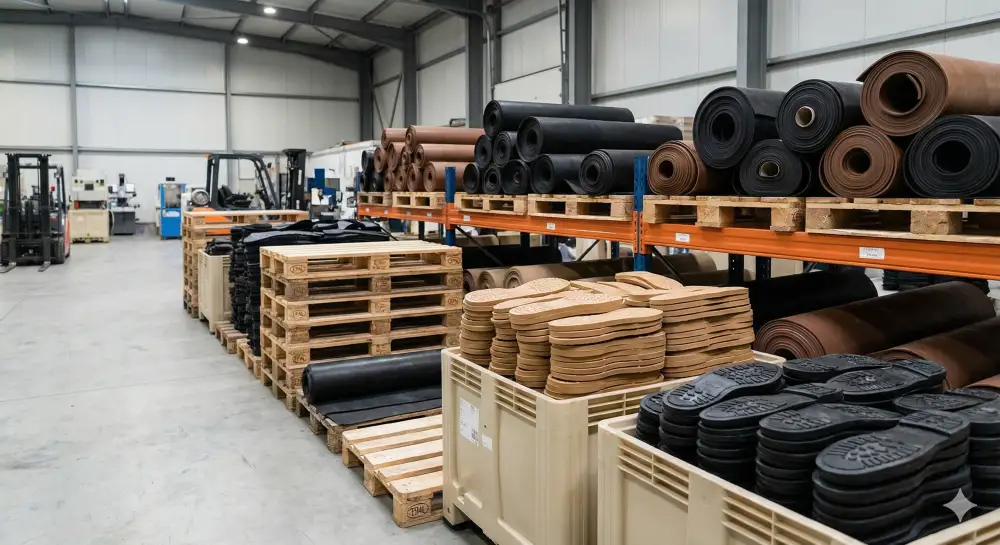
Global footwear sourcing has changed in the last decade. Vietnam and China still dominate finished-shoe production, but for component manufacturing — particularly soling materials — India has moved from “alternative supplier” to “primary option” for a growing number of international buyers.
The driver isn’t just price. It’s the combination of price, scale, English-language documentation, geopolitical diversification and a mature manufacturing ecosystem that’s been building since the 1980s. For OEM buyers exporting from India to the EU, US, MENA and Southeast Asia, the question is no longer whether to source from India — it’s which Indian supplier can deliver consistently at the volumes you need.
Choosing the wrong supplier doesn’t just risk a bad shipment. It risks missed seasonal launches, failed compliance audits, stranded inventory at customs, and reputation damage with downstream retail buyers. For exporters, supplier failure compounds — a single delayed container can break a launch window worth more than the entire order.
This guide covers why India has become a preferred sourcing destination, what to look for in an Indian footwear sole supplier, the certifications and compliance documents you need, common red flags, and how to evaluate manufacturers before placing a bulk order.
In one sentence: the best footwear sole supplier for OEM export from India is one with proven manufacturing experience, recognised international certifications, in-house quality control, and the production capacity to meet seasonal demand without compromising lead times.
Why International Footwear Brands Are Sourcing Soles from India
India has built a footwear and leather manufacturing ecosystem over decades. Several factors have brought it to the front of the global sourcing conversation:
Established manufacturing clusters. Agra (where Weston is based), Kanpur, Chennai and Bahadurgarh have developed deep supplier ecosystems with components, raw materials, skilled labour and finishing services concentrated in the same regions. This shortens internal supply chains and reduces lead times.
Cost competitiveness without quality compromise. Indian raw material and labour economics support competitive pricing. Indian manufacturers compete on quality and reliability, not just on undercutting on price.
Manufacturing depth across materials. Rubber, EVA, TPR and cork are all produced at scale in India. A single supplier can cover the full soling portfolio rather than forcing buyers to coordinate across multiple specialist sources.
English-language documentation. Contracts, technical specifications, test reports and compliance documents are produced natively in English, which reduces translation friction for international buyers and simplifies regulatory submissions.
Strategic shipping access. Major ports at Mumbai, Mundra and Chennai serve EU, MENA, Africa, US East Coast and Southeast Asia. Air freight options through Delhi and Mumbai support urgent sample dispatch and time-sensitive orders.
Government export incentives. Schemes like RoDTEP (Remission of Duties and Taxes on Exported Products) and the Footwear & Leather PLI (Production Linked Incentive) scheme reduce landed costs for export-focused buyers.
Geopolitical diversification. Single-country sourcing has become a board-level risk concern. Adding Indian suppliers reduces concentration exposure without sacrificing scale.
The result: India is now a credible primary source for footwear soles, not just a backup option to China.
Understanding the OEM Footwear Sole Supplier Model
A quick definitional note, because the term “OEM” gets used inconsistently across markets.
In footwear, OEM (Original Equipment Manufacturer) typically refers to the brand commissioning the shoes. The OEM sole supplier manufactures sole components — sheets, blockers, fore parts, top lifts, finished soles — to the OEM’s provided specifications. The supplier doesn’t design the shoe; the OEM does.
This is different from ODM (Original Design Manufacturer), where the supplier designs and manufactures finished products that brands rebrand and sell as their own. ODM is more common in apparel; OEM is more common in footwear components.
Indian footwear sole manufacturers like Weston operate in a B2B OEM model — manufacturing to provided specs, supporting technical adjustments, and supplying components at scale to the brand’s design intent.
Eight Criteria for Choosing the Best Footwear Sole Supplier in India
These are the eight things every export-focused buyer should verify before committing to a supplier relationship.
1. Years in manufacturing. Long operational history is the single most reliable signal of stable processes and dependable quality. Look for suppliers with 20+ years in business. Weston has manufactured footwear soling materials since 1987 — nearly four decades of continuous production.
2. Manufacturing infrastructure. Confirm the supplier owns its production equipment — mixing mills, hydraulic presses, EVA injection machines, TPR machinery, compression moulding systems. Suppliers without owned infrastructure are subcontracting, which weakens quality control and creates lead-time risk.
3. In-house quality control. A laboratory on-site for material testing, process control, batch consistency and pre-dispatch inspection is non-negotiable. Without it, you’re trusting the supplier’s word that the shipment matches your specification.
4. International certifications. The certifications that matter for export buyers include:
- GRS (Global Recycled Standard) — verified recycled content
- RCS (Recycled Claim Standard) — chain-of-custody for recycled materials
- ISO 9001:2015 — quality management
- REACH compliance — required for EU exports
- CPSIA compliance — required for US children’s footwear
Weston holds GRS and RCS certifications.
5. Production capacity. Ask for monthly production volumes and current capacity utilisation. A supplier running at 95% capacity has no room for your peak-season orders or unexpected volume increases.
6. Export documentation experience. IEC code, GST registration, AEO status, experience with letter-of-credit transactions and Customs House Agent relationships are non-negotiable for export buyers. A supplier learning export documentation on your order is a supplier whose paperwork will delay your shipment.
7. Reference client base. A supplier with 200+ repeat customers across India and overseas is a strong reliability signal — repeat business is the most honest reference. Ask for references in your target export market specifically.
8. Customisation and technical support. Can the supplier produce non-standard densities, hardnesses, thicknesses, colours and surface finishes? Will their technical team support new product development and tolerance discussions? OEM relationships rely on this kind of collaborative capacity.
Certifications and Compliance Every Export-Focused OEM Buyer Should Verify
Compliance is where many supplier conversations break down. Here’s the verification checklist:
Manufacturer-level certifications:
- ISO 9001:2015 — quality management system
- GRS / RCS — recycled content verification
- GOTS — for natural fibres in the broader supply chain
- OEKO-TEX — chemical safety at component level
Compliance documentation by export market:
- REACH (EU) — chemical compliance for European export
- CPSIA (US) — children’s footwear in the US
- CA Prop 65 (US) — California chemical labelling
- EUDR (EU) — deforestation regulation, particularly relevant for natural materials
Export documents:
- IEC (Import Export Code) — basic requirement for any Indian exporter
- GST registration
- Certificate of Origin — required at destination customs
- HS code expertise — incorrect HS codes cause customs delays and duty disputes
Optional but valuable:
- BSCI / Sedex — social compliance audits, often required by large retail buyers
- AEO (Authorised Economic Operator) — faster customs clearance
If a supplier can’t produce these documents on request within 48 hours, that’s a serious warning sign. Real exporters keep their documentation file current and accessible — they hand it over with a one-line email.
Red Flags When Evaluating Indian Footwear Sole Suppliers
Some warning signs are easy to spot if you know what to look for:
- No physical address verifiable on Google Maps. Likely a trading company, not a manufacturer.
- Unwillingness to share factory photos or accept a video walkthrough. Genuine manufacturers are proud of their facilities.
- “Yes to everything” responses to spec questions. A real manufacturer will push back on unrealistic specs, suggest alternatives, and flag potential issues. Universal agreement is a sign the supplier isn’t paying attention.
- No sample lead time. Quality manufacturers need 5–15 days to produce a properly compounded sample. “Same day” samples are usually inventory grabs that don’t match your spec.
- Asking for full payment upfront. Industry standard is 30% advance, 70% against shipping documents. Anything else is unusual.
- Vague or missing test certificates. No DIN abrasion, density, hardness or thickness data on request means there’s no real QC happening.
- Unwilling to sign quality agreements or NDAs. Established suppliers expect these documents and handle them routinely.
- No clear escalation contact. You need a named technical contact and a named commercial contact. “Email the general inbox” is not a contact.
Walk away if you see two or more of these signs. The cost of switching suppliers later is much higher than the cost of doing diligence properly upfront.
Running a Remote Supplier Audit Before Committing to a Bulk Order
International buyers often can’t visit India in person before placing first orders. A structured remote audit replaces the in-person visit reasonably well.
Step 1: Factory video walkthrough. Request a guided video tour covering production lines, the QC laboratory, raw material storage and finished goods warehousing. Watch for live activity — empty floors during business hours are a warning sign.
Step 2: Sample order at full spec. Test consistency by ordering two samples four weeks apart from the same specification. Compare them on density, hardness, thickness and surface finish. If two samples from the same spec differ measurably, scale-up production will be even less consistent.
Step 3: Reference call with existing clients. Ask for at least two references in your target export market. Real clients will talk; fake references won’t return your calls.
Step 4: Third-party inspection. Companies like SGS, Bureau Veritas and Intertek audit factories on your behalf for a few hundred dollars. Worth every dollar for a major supplier decision.
Step 5: Small trial order. Place a meaningful but recoverable first order before scaling. A 1,000-pair trial reveals problems a 100-pair sample never will.
A supplier comfortable with all five steps is a supplier comfortable being scrutinised. That’s the signal you want.
Why Export-Focused OEM Buyers Work With Weston Rubber Industries
Weston Rubber Industries meets every criterion above:
- Since 1987 — nearly four decades of continuous footwear soling manufacturing experience
- Full in-house infrastructure — mixing mills, hydraulic presses, EVA injection machines, TPR machinery, compression moulding systems
- In-house QC laboratory — material testing, process control, batch consistency checks and pre-dispatch inspection
- GRS and RCS certified — verified recycled content for sustainability-led buyers
- Full product range — rubber sheets and soles, EVA sheets and soles, TPR soles, cork footbeds and Performa/lightweight/Tunit sheets
- 200+ repeat customers across India and overseas — proven reliability
- Customisation across density, hardness, thickness, colour and surface finish
- Located in Agra, Uttar Pradesh — well connected to Mundra and Mumbai ports for EU, MENA and US export routes
For OEM buyers consolidating multiple component categories with one supplier, Weston’s full soling portfolio is itself a sourcing advantage — one supplier, one quality standard, one logistics relationship.
For more detail on the company and infrastructure, see the About Us page and full product range.
Sourcing Footwear Soles from India — Frequently Asked Questions
Why source footwear soles from India instead of China or Vietnam?
India offers competitive pricing, English-language documentation, a mature footwear manufacturing ecosystem and reduced geopolitical concentration risk. For component manufacturing specifically — soling materials, sheets, finished soles — India’s production scale and quality standards are now comparable to other major sourcing markets.
What’s the typical MOQ for OEM footwear sole orders from India?
MOQs vary significantly by product type, customisation level and supplier capacity. Contact suppliers directly with your specifications for an accurate MOQ quote.
What’s the standard lead time for export orders?
Standard production lead times are typically 4–8 weeks depending on order size, customisation and current production load. Shipping from Indian ports to EU/US destinations adds 3–5 weeks via sea freight.
What’s the typical payment structure for export orders from India?
Standard terms are 30% advance and 70% against shipping documents, often through letter of credit for larger orders. Variations exist by supplier and relationship maturity.
Can Indian suppliers manufacture to international compliance standards (REACH, CPSIA)?
Yes. Established Indian footwear component manufacturers routinely produce to REACH, CPSIA, CA Prop 65 and other international compliance standards. Verify certifications before ordering.
What types of footwear soles can I source from India?
The full range — rubber soles and sheets, EVA soles and sheets, TPR soles and components, cork footbeds, and specialty lightweight materials. Weston supplies all of these.
How do I verify if an Indian supplier is a real manufacturer and not a trader?
Request a factory video walkthrough, verify the physical address on Google Maps, ask for production photos with date stamps, and check for in-house QC equipment. Traders typically can’t provide these.
Which Indian ports are best for footwear exports?
Mumbai and Mundra (Gujarat) serve EU, MENA and East African markets best. Chennai serves Southeast Asia and East Asia. Both Mumbai and Mundra have well-established footwear export infrastructure.
Build a Reliable Footwear Sole Supply Chain from India
Sourcing from India can deliver significant cost and quality advantages for OEM footwear buyers — but only if the supplier relationship is built on the right foundations: manufacturing experience, in-house quality control, certifications, and export documentation capability.
Weston Rubber Industries supplies footwear soling materials to manufacturers across India and overseas, with nearly four decades of OEM production experience, GRS and RCS certifications, and a complete in-house production and quality control setup.
If you’re evaluating Indian suppliers for export-focused OEM footwear production, share your specifications, target market and volume requirements with our team. We’ll respond with pricing, samples, certifications and lead times.