

Blog
Rubber Blockers vs Rubber Soles vs Rubber Sheets: Which Format Should You Order?

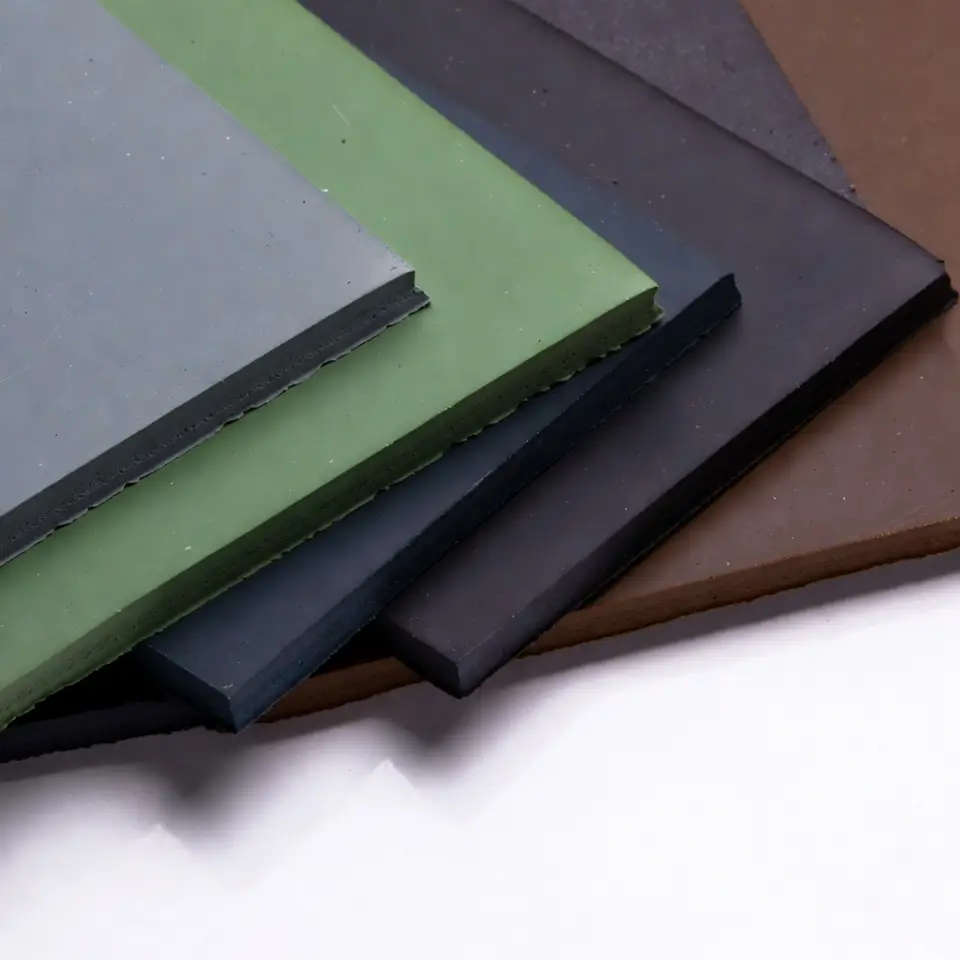
Rubber is rubber. Same material, same compound family — but order it in the wrong format for your production line and you’ve created a problem before the first component is assembled. Blockers arriving into a factory with no band saw. Sheets ordered when you needed finished components that can go straight to the bonding line. Finished components arriving when your whole operation is set up to cut from sheet.
It sounds obvious, but this happens. And the reason it happens is that “rubber soles” means different things depending on where you are in the supply chain. A finished rubber fore part and a rubber sole sheet and a rubber blocker are all “rubber soling material” — but they serve completely different buyers at completely different stages of production.
This guide sorts it out. By the end you’ll know which format fits your operation, what’s in each category, and how to make the decision quickly for any brief. Weston supplies all three from one facility — rubber soles (finished components), rubber sheets, and rubber blockers — so this is a genuinely neutral comparison.
The Three Rubber Formats: What’s Actually in Each One
Before we compare them, it’s worth being clear about what each format actually contains — because ‘rubber soles’ is genuinely ambiguous depending on who’s using the term.
Rubber Soles — finished, ready-to-assemble components
When Weston says “rubber soles,” they mean finished, pre-shaped components that go directly into the shoe construction without any further cutting or machining. Three products sit in this category: rubber blockers (raw block format — addressed separately below), rubber fore parts (finished forefoot component), and rubber top lifts (finished heel component). The fore parts and top lifts arrive shaped and ready. You bond, stitch, or nail them in. Done.
Rubber Sheets — flat raw material for die cutting and pressing
Three sheet types, each engineered for a specific zone of the shoe. Rubber sole sheets for full outsole die-cut production. Rubber fore parts sheets for forefoot component cutting. Rubber top lifts sheets for heel toplift production — available 3mm–7mm thickness, 24″×36″ standard size, with DIN abrasion ≤150 cu mm achievable. All three are flat raw material: you bring the die cutter, the press, or the CNC machine, and you form the component yourself.
Rubber Blockers — three-dimensional raw blocks for custom processing
Rubber blockers are solid rubber blocks — natural rubber, synthetic rubber, or compound blends — supplied for secondary processing into any component the manufacturer needs. Band saw cutting, CNC machining, die cutting, skiving, compression moulding: all compatible. Shore A hardness customisable across compound grades. Maximum dimensional freedom, maximum material yield. The catch: you need the equipment to process them, and you need more lead time before components reach the assembly line.
Head-to-Head: Eight Variables That Tell You Which to Order
If you already know roughly what you need, scan this table. If you’re less sure, read through the next three sections and then use the decision framework.
| Variable | Rubber Soles (finished) | Rubber Sheets | Rubber Blockers |
| Processing needed | None — bond or stitch | Die cut / press / CNC | Full: saw / CNC / skive |
| Equipment required | Assembly / bonding only | Die cutter, press or CNC | Band saw, CNC, skiving machine |
| Dimensional flex | Fixed to moulded profile | Medium — flat geometry | Maximum — any profile, any thickness |
| What’s in the range | Blockers, fore parts, top lifts | Sole, fore parts & top lifts sheets | Blockers only |
| Hardness scale | Shore A | Shore A | Shore A |
| Abrasion benchmark | Per compound / product | ≤150 cu mm (DIN) for heel sheets | Per compound spec |
| Time to component | Fastest — no processing | Medium — cut then assemble | Slowest — process then assemble |
| Best for | Assembly-only; no cutting equipment | Volume flat production with die cutters | Custom profiles; max yield; in-house cutting |
| The one thing that overrides everything else: Equipment capability determines format more than any other factor. If your factory has no band saw, CNC, or die cutting capability, the right answer is always finished rubber soles — regardless of what the cost-per-unit comparison looks like. Receiving sheets or blockers into an assembly-only operation creates a processing step you can’t complete. |
When to Order Finished Rubber Soles (Fore Parts and Top Lifts)
Finished rubber sole components — specifically fore parts and top lifts — are the right format when your production workflow starts at the bonding or stitching stage. You receive a shaped component, you attach it to the shoe. No cutting step, no intermediate processing.
Order finished rubber fore parts or top lifts if:
- Your facility bonds or stitches components together without in-house die cutting or CNC
- You need a specific pre-shaped heel or forefoot component that’s ready for immediate assembly
- You’re a shoe repair or resoling operation that attaches replacement components without cutting equipment
- Speed to assembly line is the priority — no processing step between delivery and production
The constraint worth knowing: finished components are dimensionally fixed. If you need a non-standard size or profile that isn’t available in Weston’s moulded range, sheets or blockers give you more control. But for standard forefoot and heel component production in any of the confirmed application categories — formal footwear, safety boots, school shoes, repair work — the finished format removes processing steps and gets you to assembly faster.
Deep-dive guides for each finished component: Rubber Fore Parts and Rubber Top Lifts.
When to Order Rubber Sheets
Rubber sheets suit operations with die cutting, press moulding, or CNC capability running high-volume flat-geometry production. The sheet format is the bridge between raw material and finished component — you do the forming step in-house, which gives you more dimensional control and volume efficiency than finished components, but less flexibility than blockers.
And the sheet type matters — these aren’t interchangeable:
- Rubber sole sheets — for die-cutting full outsole components; the flat outsole production workhorse
- Rubber fore parts sheets — specifically formulated for forefoot applications; flex resistance optimised for the toe bend zone; compatible with die cut, press mould, buff, and CNC
- Rubber top lifts sheets — high-density compound for heel strike applications; DIN abrasion ≤150 cu mm achievable; 3mm–7mm thickness; 24″×36″ standard sheet; die cut, press mould, or CNC
Order rubber sheets if:
- You have die cutting or CNC equipment and run volume flat-geometry production
- You need consistent thickness tolerances across large production runs — sheets give you more thickness control than cutting from a block
- Your forefoot or heel components have standard flat geometry that doesn’t require 3D profiling
- You want to optimise material yield at scale through efficient nesting on flat sheet
The constraint: flat geometry only. Sheets can’t produce bevelled edges, contoured profiles, or non-standard combined thicknesses in a single cut. If your component requires 3D profiling or custom combined dimensions, blockers are the better raw material.
For more on sheet types: Rubber Sole Sheets Explained.
When to Order Rubber Blockers
Rubber blockers are the most flexible format — and the most demanding on production capability. A solid rubber block of natural rubber, synthetic rubber, or engineered compound gives you a three-dimensional volume of consistent material to cut whatever component you need at whatever dimension you need. The block doesn’t constrain you to flat geometry or fixed thickness the way a sheet does. You decide the profile, the thickness, the cross-section.
But here’s what that actually means in practice: band saw cutting for primary slicing, CNC or die cutting for final geometry, skiving for thickness reduction, compression moulding for shaped profiles. This is a serious in-house processing workflow. If your factory doesn’t have that capability, blockers become an obstacle rather than a raw material.
Order rubber blockers if:
- You have band saw, CNC, die cutting, and/or skiving equipment in-house
- You need non-standard profiles, combined thicknesses, or bevelled geometries that flat sheets can’t produce
- You produce custom, bespoke, or small-batch footwear where the specification changes frequently
- Maximum material yield is a production priority — cutting from a block wastes less than working around pre-set flat sheet thickness
- You’re an OEM component manufacturer cutting to customer spec across varying profiles
| Important: Shore A, not Asker CRubber blockers are specified in Shore A — the correct hardness scale for solid rubber. Not Asker C, which is the scale for EVA foam. If a supplier quotes Asker C for rubber compound, the data is unreliable. More on this in the Shore A hardness guide. |
For the full guide to blockers across all three materials (EVA, rubber, TPR): What Are Shoe Blockers?.
Five Questions That Tell You Exactly Which Format to Order
Work through these in order. Each question routes you to a format or moves you to the next one. No hedging — just decisions.
| Q1: Does your facility have die cutting, CNC, or band saw capability?No → Order finished rubber soles (fore parts and/or top lifts).Without cutting equipment, you need a component that arrives ready. Sheets and blockers both require forming before use — finished components don’t. |
| Q2: Do you need a non-standard profile, bevelled edge, combined thickness, or 3D geometry?Yes → Order rubber blockers.Flat sheets can’t produce these. Blockers give you a solid volume to cut any geometry from. If your geometry is flat and standard, proceed to Q3. |
| Q3: Is the component a full outsole cut to flat geometry at volume?Yes → Order rubber sole sheets.High-volume flat outsole production with die cutting is the primary use case for rubber sole sheets. Standard thickness, consistent compound, efficient nesting on sheet. |
| Q4: Is the component a forefoot zone part (fore part) cut from flat sheet material?Yes → Order rubber fore parts sheets.These are specifically formulated for the forefoot flex zone — different compound optimisation from general sole sheets. Don’t substitute one for the other. |
| Q5: Is the component a heel toplift cut from flat sheet material?Yes → Order rubber top lifts sheets (3mm–7mm, 24″×36″, DIN abrasion ≤150 cu mm achievable).High-density heel compound, specific thickness range, proven abrasion benchmark. If you need a pre-shaped finished toplift instead of cutting it yourself, order the finished rubber top lifts. |
| Still not sure? That’s what the enquiry form is for.Tell Weston your application, what equipment your factory has, and your volume. They’ll advise on the right format and send samples before you commit. Getting it right before ordering costs nothing. Getting it wrong costs a production run. |
Why Getting All Three Formats from One Supplier Makes Sense
Production requirements change. An operation running on finished components might add die cutting capability and move to sheets. A factory cutting from sheets might scale up to blockers for better yield. When that happens, the format should change — but the supplier relationship shouldn’t have to.
- All three rubber formats from one facility. Rubber soles (fore parts, top lifts), rubber sheets (sole, fore parts, top lifts), and rubber blockers — all from Weston’s facility in Agra, India. Format changes don’t require a new supplier, a new QC review, or a new compliance documentation set.
- Same Shore A specification across formats. Compound hardness and grade specifications transfer directly when you switch formats. No re-qualification of material performance when you move from sheet to block or finished to sheet.
- Verified abrasion data. The DIN abrasion ≤150 cu mm benchmark is achievable in Weston’s rubber top lifts sheet and toplift compound. That’s a number you can hold a supplier to — not a description.
- In-house QC across all rubber products. Shore A consistency, thickness tolerance, and compound uniformity verified before dispatch on every order. Batch-to-batch consistency is documented, not assumed.
- Natural rubber, synthetic rubber, and compound blends. The right compound for the application — advised per brief, not defaulted.
- 37 years of rubber manufacturing. Since 1987. That’s not a tagline — it’s compound process knowledge that doesn’t exist in a supplier who started five years ago.
Frequently Asked Questions
What’s the difference between a rubber sole and a rubber sole sheet?
A rubber sole (in the sense of a finished component like a fore part or top lift) arrives pre-shaped and ready to bond or stitch into the shoe without any further processing. A rubber sole sheet is flat raw material — you die cut or CNC machine it into components yourself. The right format depends entirely on whether your factory has cutting equipment. Assembly-only operations order finished components. Operations with die cutting capability may prefer sheets for volume flat production.
Can rubber blockers replace rubber sheets in production?
Blockers and sheets aren’t direct substitutes — they suit different production contexts. Rubber blockers give you maximum dimensional freedom (any profile, any thickness from the block) and higher material yield, but they require band saw, CNC, or skiving equipment and more processing time. Rubber sheets are faster to process at volume for flat-geometry components and give consistent thickness tolerances across large runs. Choose based on your component geometry and equipment capability, not cost alone.
Is there a difference between rubber fore parts sheets and rubber sole sheets?
Yes, and it matters. Rubber fore parts sheets are specifically formulated for the forefoot flex zone — the compound optimises for flex fatigue resistance alongside abrasion performance. Rubber sole sheets are a more general outsole material. They’re not the same compound and shouldn’t be substituted for each other in a precision specification. Rubber top lifts sheets are a third distinct product, engineered for high-density heel strike applications with a specific thickness range (3mm–7mm) and verified DIN abrasion performance.
Does it matter which hardness scale is used for rubber compound specs?
It does, actually. Rubber products — blockers, sheets, and finished components — should all be specified in Shore A, which is the correct hardness scale for solid rubber materials. Asker C is the correct scale for EVA foam and doesn’t apply to rubber. If a supplier quotes Asker C for rubber compound, the specification data is unreliable. The Shore A hardness guide on Weston’s site explains this in full.
Does Weston Rubber supply all three rubber formats from the same facility?
Yes. Rubber soles (finished fore parts and top lifts), rubber sheets (sole sheets, fore parts sheets, and top lifts sheets), and rubber blockers are all manufactured at Weston’s facility in Agra, India. All three formats share the same Shore A compound range, in-house QC process, and compound expertise accumulated since 1987. Switching between formats as your production requirements evolve doesn’t require changing suppliers.
The Short Version
No cutting equipment? Order finished rubber fore parts and top lifts. High-volume flat production with die cutters? Order the right sheet for the right zone — sole, fore parts, or top lifts sheets. Custom profiles, 3D geometry, maximum yield from raw material? Order rubber blockers. And if you’re producing across more than one of those categories, Weston makes all three formats from one facility with consistent compound specs across everything.