

Blog
Abrasion Resistance vs. Slip Resistance vs. Flexibility: Understanding Sole Performance Trade-offs

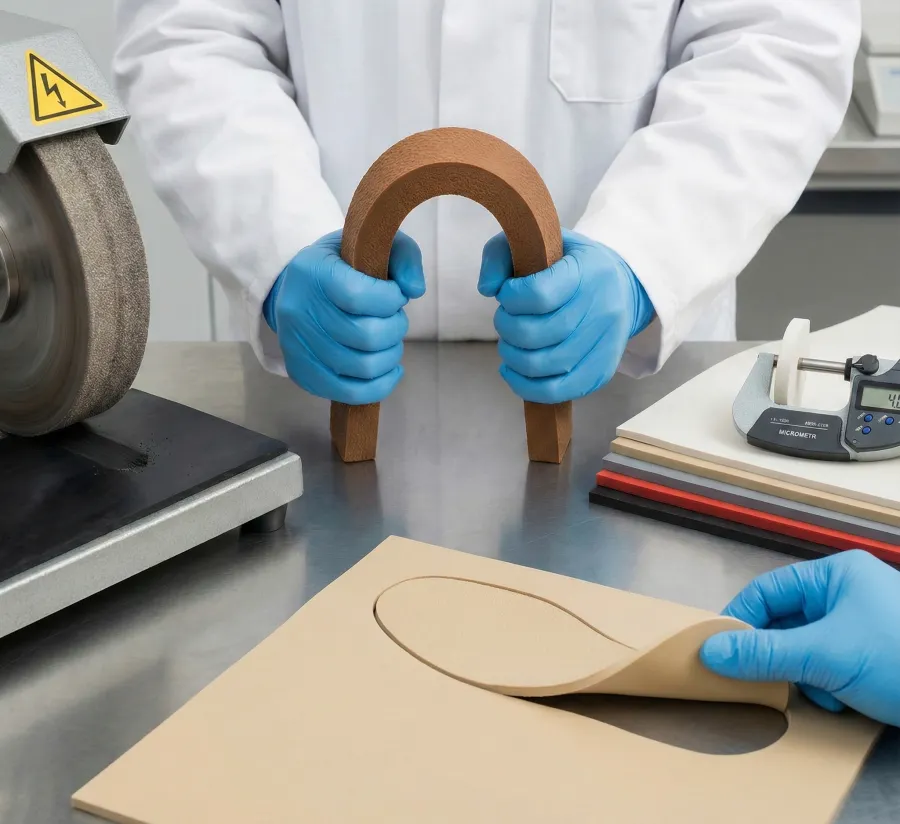
For footwear product managers, procurement directors, and design engineers, selecting the ideal soling compound is a balancing act of polymer chemistry. In an ideal world, every shoe would feature an outsole that is completely immune to abrasive wear, grips flawlessly on wet or oily steel plates, and flexes effortlessly with the natural biomechanics of the foot.
In elastomer engineering, however, these three properties sit at competing ends of a technical continuum. Maximizing one performance metric almost always forces a compromise in another.
To help procurement teams navigate these engineering compromises without sacrificing field performance, we break down the molecular trade-offs between abrasion resistance, slip resistance, and flexibility—and explain how to optimize your compound formulations for specific target environments.
The Molecular Battlefield: Hardness vs. Coefficient of Friction (CoF)
To understand why these trade-offs exist, we must look at the physical properties of the primary soling polymers: Vulcanized Rubber, Ethylene-Vinyl Acetate (EVA), and Thermoplastic Rubber (TPR).
- Abrasion Resistance requires a high modulus, cross-linked polymer matrix with high tear strength to resist shearing forces. This is typically achieved by increasing polymer density, maximizing vulcanization cross-linking (t90), or adding reinforcing agents like carbon black.
- Slip Resistance (Grip) relies on a material’s viscoelasticity—its ability to deform rapidly at a microscopic level to conform to the rough textures of the walking surface, maximizing the true contact area. This requires a softer compound with a lower modulus and higher surface tack.
- Flexibility requires low flexural modulus and excellent elongation properties, allowing the compound to bend repeatedly along high-stress pivot zones without crack propagation.
When you alter a compound to boost one of these attributes, the chemical shifts ripple across the other two.
Engineering Trade-Off #1: Abrasion Resistance vs. Slip Resistance
This is the most common conflict in utility and industrial safety footwear.
The Conflict
To maximize abrasion resistance—measured by low volume loss in DIN Abrasion Testing (ISO 4649)—engineers often increase the compound’s hardness (Shore A) and integrate high-molecular-weight polymers like Polybutadiene Rubber (PBR). While this prevents the tread lugs from “balding” on abrasive concrete or gravel, it severely limits the elastomer’s ability to deform microscopically.
When a hard, highly abrasion-resistant outsole encounters a smooth, wet, or oily surface, it cannot achieve the microscopic surface contact required to establish a high Coefficient of Friction (CoF), leading to slip failures. Conversely, a soft, high-grip compound (like a soft rubber or a high-tack TPR) will grip brilliantly but shear away rapidly when subjected to friction, causing premature wear.
How to Optimize
- For Industrial/Work Boot Specs: Prioritize a vulcanized rubber compound blended with structural PBR, targeting a Shore A hardness of 65 to 70. This caps DIN abrasion loss to <150 mm³ while maintaining acceptable grip via aggressive, self-cleaning lug geometries rather than raw material tackiness.
- For Indoor Service/Hospitality Specs: Sacrifice raw abrasion resistance for slip safety. Utilize a softer formulation (Shore A 55 to 60) tested explicitly under ASTM F2913 (whole shoe slip testing) to guarantee a wet/oily CoF greater than 0.60.
Engineering Trade-Off #2: Flexibility vs. Durability (Abrasion)
This trade-off dictates the lifespan of athletic, running, and tactical footwear where the sole must bend thousands of times per day.
The Conflict
True flexibility is achieved by lowering the thickness of the outsole or using low-density materials like blown EVA or low-modulus elastomers. However, when density drops, the cell walls or polymer chains become structurally vulnerable.
If a manufacturer lowers compound density to pass aggressive flex-fatigue tests such as the SATRA TM92 or Ross Flexing Test (ASTM D1052) the material loses its mechanical resistance to tearing and puncturing. Under abrasive friction, the cells pull apart easily, causing the sole to wear flat in weeks.
How to Optimize
- The Dual-Density Solution: Do not expect a single material to handle both requirements. The industry standard for performance footwear is to pair a low-density, high-flexibility midsole (such as a compressed EVA foam) with a thin, high-density, vulcanized rubber perimeter outsole skeleton.
- This architecture allows the shoe to flex effortlessly along the footbed while ensuring that only the highly durable, abrasion-resistant rubber faces contact the ground. You can explore how different base materials manage this interaction in our breakdown of Rubber Blockers vs. Rubber Soles vs. Rubber Sheets.
Engineering Trade-Off #3: Slip Resistance vs. Flexibility
This conflict is most apparent in cold-weather footwear and technical outdoor applications.
The Conflict
At room temperature, a highly flexible sole often exhibits good slip resistance because both traits benefit from a lower material modulus. However, the conflict arises during temperature drops or when altering the compound’s chemical plasticizers.
To reduce material costs or alter flexibility, some factories “over-fill” formulations with cheap mineral fillers (like calcium carbonate). This maintains the shape and stiffness but introduces brittleness. Under flex testing, these over-filled matrices experience micro-cracking along the flex lines. Simultaneously, the fillers dry out the compound’s surface tack, destroying its slip resistance on smooth surfaces.
How to Optimize
- Keep Fillers in Check: Ensure your manufacturing partner monitors rheometer curves and specific gravity metrics rigorously to prevent over-filling. For components handling high-stress zones, like TPR fore parts, maintaining precise control over cross-linking is mandatory to protect flexibility without ruining traction.
- Temperature Calibration: For outdoor or safety footwear, specify polymers with a low glass transition temperature (Tg), such as specific Nitrile Rubber blends, ensuring the sole remains flexible and slip-resistant even in sub-zero environments.
The Strategic Procurement Matrix
When sourcing components from your manufacturing partner, use this quick reference matrix to align your material specs with the shoe’s intended environment:
| Footwear Category | Primary Priority | Secondary Priority | Recommended Soling Compound Specification |
|---|---|---|---|
| Industrial / Safety Boots | Abrasion Resistance | Slip Resistance | High-density Vulcanized Rubber; Shore A: 65–70; DIN Abrasion: <120 mm³ |
| Elite Athletic / Running | Flexibility & Rebound | Abrasion Resistance | Dual-density: Injection-molded EVA midsole for flex, paired with a zoned Nitrile/PBR rubber outsole |
| Indoor Work / Tactical | Slip Resistance (CoF) | Flexibility | High-viscoelasticity TPR or Low-durometer Rubber; Shore A: 55–60; ASTM F2913 Wet CoF: >0.60 |
By understanding these chemical and mechanical balances, product managers can write highly accurate tech packs, avoid costly field failures, and select the exact formulation required for their target market. For a comprehensive comparison of how these material families stack up across cost, weight, and durability benchmarks, read our core guide on EVA vs. Rubber vs. TPR.
Frequently Asked Questions (FAQ)
Can a soling compound achieve both elite DIN abrasion scores and premium slip resistance at the same time?
Natively, no. They represent an engineering contradiction. High abrasion resistance requires a rigid, highly cross-linked molecular structure (high modulus) that prevents material shredding under friction. High slip resistance relies on viscoelastic deformation—the material must easily “flow” into microscopic floor imperfections to build a high Coefficient of Friction (CoF). To bypass this, brands rely on dual-compound construction or smart geometric tread patterns that channel away liquids while preserving compound stiffness.
Why does adding cheap fillers to a rubber compound ruin its flexibility?
When factories substitute active polymers with excess inert fillers like calcium carbonate to slash costs, they disrupt the continuous rubber matrix. The polymer chains become interrupted by mineral particles that cannot bend or elongate. Under repetitive mechanical stress, these filler sites act as microscopic stress concentrators, causing rapid micro-cracking across the main flex zones of the sole.
How does temperature affect the balance between slip resistance and flexibility?
As the temperature plunges, elastomers reach their glass transition temperature (Tg), changing from flexible, rubbery materials to rigid, glassy structures. When a sole stiffens in the cold, it loses both its flexibility and its capacity to deform micro-texturally against surfaces, causing a sharp drop in slip safety. To prevent this, specialized cold-weather compounds utilize specific base materials like Nitrile or specialized rubber additives to depress the Tg point.
What is the most effective way to test flexibility before mass production?
The industry gold standards are the SATRA TM92 and the Ross Flexing Test (ASTM D1052). These machines physically punch a tiny starter cut into the flex line of an outsole and mechanically bend it tens of thousands of times under a specified angle. Measuring the speed of crack growth under these rigid conditions gives development teams an empirical map of how the compound will hold up to daily walking stress over a multi-year life cycle.