
Blog
What Are TPR Fore Parts? Flexible Forefoot Components for Casual and School Footwear

Not every shoe needs the maximum abrasion resistance of natural rubber at the forefoot. Honestly, for a lot of footwear — casual shoes, school shoes, lifestyle trainers, fashion footwear — that would be over-engineering the spec and over-pricing the product. What those categories actually need is a forepart that flexes cleanly through thousands of daily bend cycles, holds up through a full school year or a season of casual wear, grips reliably on the surfaces the wearer actually walks on, and comes in at a cost structure that makes the product viable at its price point.That’s exactly the brief that TPR fore parts were designed for. Thermoplastic rubber at the forefoot: lighter than natural rubber, genuinely excellent flex fatigue resistance, good abrasion performance for the application category, recyclable, and cold-climate friendly in a way that vulcanized rubber simply isn’t. This guide explains what TPR fore parts are, where they perform best, and how they compare to rubber when you’re deciding which forepart material to specify. Weston’s TPR fore parts are finished, ready-to-assemble components made in Agra, India.
What Is a TPR Fore Part?
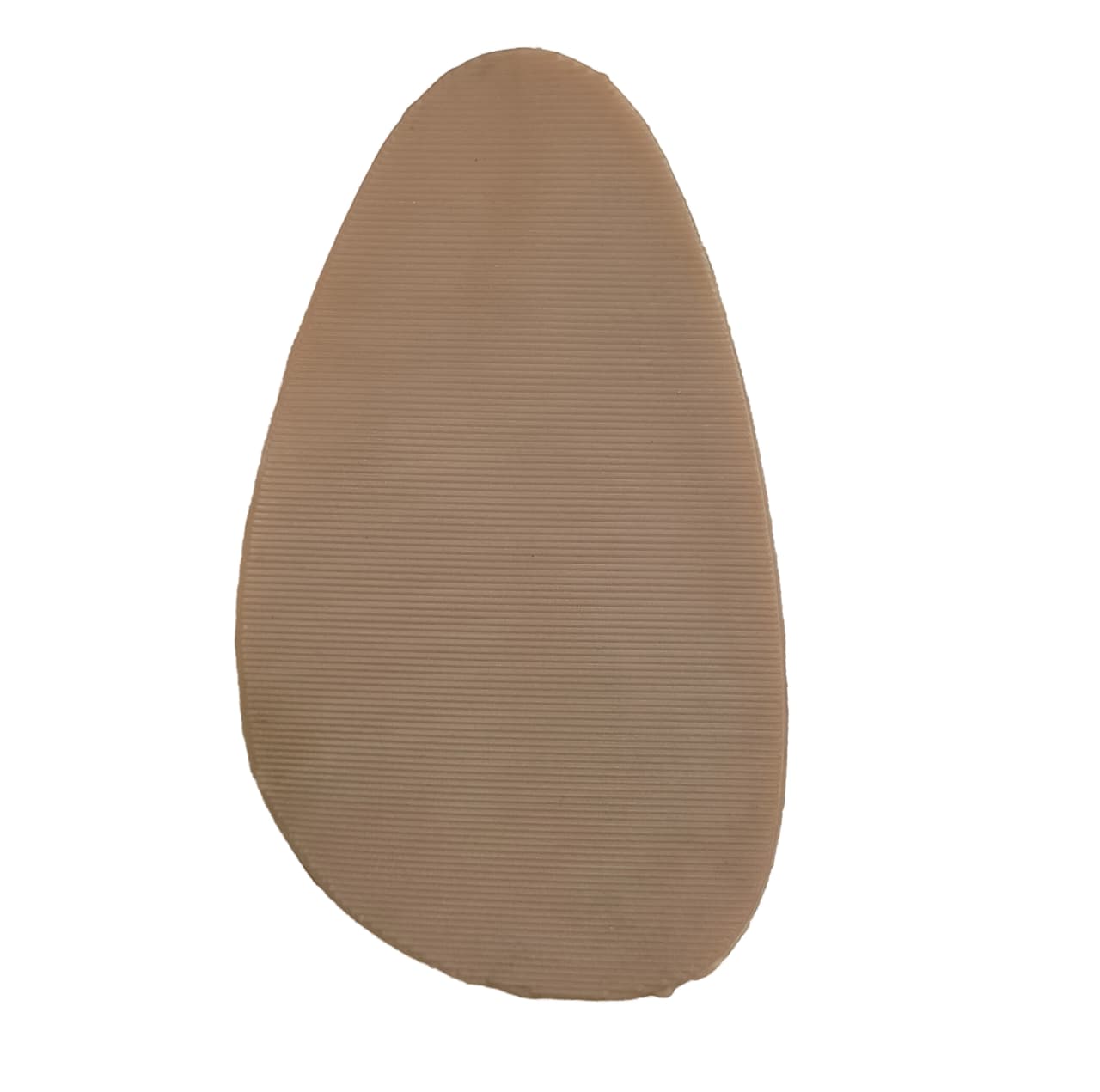
A TPR fore part is a finished, pre-shaped outsole component covering the front third of the shoe sole — from behind the ball of the foot to the toe. It’s manufactured from thermoplastic rubber, typically by injection moulding, which produces precise dimensions and consistent quality across high-volume production runs. It arrives ready to bond or stitch into the shoe construction without any cutting or machining on your end.
Thermoplastic rubber is the key. Unlike vulcanized rubber — which undergoes a permanent chemical cure and can’t be reprocessed — TPR is a block copolymer that behaves like rubber at room temperature but melts and reflows above its softening point. That’s what makes it recyclable, and it’s also what gives it the cold-temperature flexibility advantage over natural rubber. The polymer chains don’t cross-link the way vulcanized rubber does, so the material stays pliable in cold conditions where rubber might stiffen.
The forefoot zone is the right application for TPR precisely because the dominant stress there is flex fatigue — repeated bending rather than concentrated impact. TPR handles that excellently. It’s the heel zone, with its high concentrated impact load, where rubber’s density and mechanical strength advantage becomes more significant. Which is why you’ll often see TPR fore parts paired with rubber or higher-density TPR top lifts in the same shoe.
| The forefoot stress is bending, not impactEvery stride flexes the front third of the sole through a complete bend cycle. In casual and school footwear, that happens thousands of times per day across months of wear. The forepart material’s job is to bend without cracking or fatiguing — which TPR does as well as rubber, at lower weight and lower cost for this application. |
What TPR Actually Does at the Forefoot
Here’s the practical picture — what you’re actually getting when you specify TPR at the forefoot zone.
| What TPR does | What that means for the shoe |
| Flex resistance — no cracking | Thousands of bend cycles at the toe zone, day after day — TPR handles them without splitting or fatiguing |
| Good abrasion resistance | Holds up well at the forefoot surface; won’t wear through quickly under normal daily use conditions |
| Lighter than rubber | Less weight per component than equivalent rubber fore parts — relevant for products where overall shoe weight is part of the brief |
| Cold-temperature flexibility | Stays pliable in cold conditions where rubber can stiffen; the clear TPR advantage for cold-climate markets |
| Reliable grip | Solid slip resistance on tiles, pavements, and indoor surfaces — the surfaces most casual and school footwear encounters |
| Shock absorption at push-off | Cushions the toe-lever stress at the end of each stride; contributes to comfort without adding foam layers |
| Shore A hardness — customisable | Multiple grades available — softer for comfort-priority; firmer for footwear that needs more outsole structure |
| Recyclable material | TPR is thermoplastic — it can be remelted and reprocessed, unlike vulcanized rubber which can’t |
| Adhesive bonding compatibility | Bonds cleanly with standard footwear adhesives; no surface preparation issues in standard assembly lines |
| Colour and finish options | Full colour range and surface texture options, consistent across every production batch |
A couple of things worth pausing on. The cold-temperature flexibility advantage is real and not just a technicality — if you’re producing footwear for markets where winter temperatures drop below 5°C, natural rubber foreparts can feel noticeably stiffer underfoot. TPR doesn’t have that problem. And the recyclability point is increasingly a commercial consideration for brands responding to sustainability requirements from retail partners — TPR is a more defensible material choice in that conversation than vulcanized rubber.
On Shore A: TPR fore parts are specified in Shore A — the correct hardness scale for solid elastomers, not Asker C which applies to EVA foam. Weston’s TPR fore parts are available across multiple Shore A grades. For forepart applications, softer grades suit comfort-priority casual footwear; firmer grades suit school shoes and lifestyle footwear where outsole structure matters. The Shore A hardness guide explains the full scale and footwear-specific ranges if you want the numbers.
TPR or Rubber? The Honest Answer for Fore Parts
Weston makes both. So let’s be straight about where each one wins, because the right answer genuinely depends on the footwear category and what you’re optimising for.
| TPR Fore Parts | Rubber Fore Parts | |
| Abrasion resistance | Good | Highest — the rubber advantage |
| Flex resistance | Excellent | Excellent |
| Weight | Lighter | Heavier |
| Cold-climate flex | Stays flexible — TPR wins here | Can stiffen in extreme cold |
| Recyclable | Yes — thermoplastic | No — vulcanized rubber |
| Cost structure | Mid-market efficient | Higher — justified for premium/safety |
| Best categories | Casual, school, lifestyle, fashion, cold climate | Formal, safety, outdoor, premium, repair |
TPR fore parts are the right call when:
- You’re producing casual, school, lifestyle, or fashion footwear where maximum abrasion resistance isn’t the priority brief
- Weight is part of the product specification and you want a lighter forepart without compromising flex performance
- Cold-climate markets are in scope — TPR stays flexible at low temperatures where rubber stiffens
- Recyclability matters to your brand sustainability brief or your retail partner requirements
- Cost efficiency at volume is a genuine constraint for the product’s price point
Rubber fore parts are the right call when:
- Maximum abrasion resistance and material premium are the spec — formal footwear, safety boots, outdoor — see Rubber Fore Parts for that brief
- You’re replacing a rubber forepart in a repair job and need compound match
- Safety footwear certifications require rubber-grade abrasion and slip performance
Where TPR Fore Parts Actually Get Specified
The categories below are where TPR fore parts consistently perform well — and why TPR is typically the smarter choice for each of them over rubber.
School and uniform footwear
This is honestly the strongest TPR forepart application. School shoes take more forefoot flex stress than almost any other footwear category — children run, jump, kneel, and drag their feet in ways that adult wearers simply don’t. The forefoot zone gets battered. And school shoe budgets mean that paying a premium for natural rubber forepart compounds often doesn’t make commercial sense when TPR delivers equivalent flex fatigue resistance at lower cost. The weight advantage also matters: lighter shoes are simply better for children wearing them all day.
Casual and everyday footwear
The largest volume category for TPR foreparts globally. Casual footwear — trainers, loafers, moccasins, everyday lace-ups — needs a forepart that holds up through daily use without the cost overhead of rubber. TPR delivers good abrasion resistance for normal walking conditions, clean flex performance, and the grip you need on the surfaces casual shoes actually encounter: pavement, tile, indoor flooring. It’s not the right spec for heavy outdoor use or safety applications, but that’s not what most casual shoes are doing.
Lifestyle and fashion footwear
Fashion footwear moves through seasonal cycles quickly, which means forepart specifications need to be flexible — in Shore A grade, colour, surface texture, and profile. TPR injection moulding supports all of those variables efficiently. Colour consistency across batches matters in fashion contexts: a forepart that comes in slightly different shade between production runs creates visible inconsistency in the finished shoe. Weston’s in-house QC addresses this specifically.
Cold-climate and winter footwear
If any single factor makes TPR the obvious forepart choice over rubber for certain markets, it’s this one. In temperatures below 5°C, natural rubber compounds — particularly harder-grade compounds — can stiffen noticeably, which changes how the forepart flexes with the foot and can create an uncomfortable, wooden feel underfoot. TPR maintains its elasticity and pliability across a wider temperature range. For footwear sold into northern European, Central Asian, or high-altitude markets, TPR foreparts are the practical specification choice.
Mass-market and private-label production
High-volume OEM production at mid-market price points needs forepart components that are consistent, cost-efficient, and available at scale without quality drift between batches. TPR injection moulding is specifically good at this: the thermoplastic process produces precise dimensions and uniform compound distribution across very large production runs. For procurement managers managing volume OEM contracts, batch-to-batch TPR consistency is as important as the initial compound specification.
What to Look for in a TPR Fore Parts Supplier
Same principle as any forepart procurement: the sample approval is the easy part. What actually determines whether you have a good supplier is what happens at batch six, or batch twenty. Here’s the checklist.
- Shore A hardness range. Multiple grades available and advised per application. Not a single compound applied to every brief. Softer for comfort-priority casual; firmer for school and structured footwear.
- Injection moulding quality. Precise dimensions, consistent thickness, and clean edges across every batch — that’s what injection moulding should deliver. Confirm that it actually does with sample validation before volume commitment.
- Colour and surface texture consistency. Every batch, not just the first. This matters more for fashion and lifestyle footwear than for school shoes, but it matters everywhere in production.
- Adhesive bonding compatibility. TPR fore parts should bond cleanly with standard footwear adhesives without surface preparation issues. Weston’s TPR fore parts are confirmed for strong bonding compatibility in standard assembly workflows.
- Rubber and TPR from one facility. If your range uses both materials — rubber fore parts for formal lines, TPR for casual — sourcing both from Weston means one QC system, one supplier relationship, and compound specifications that are directly comparable between the two.
- In-house QC with batch documentation. Shore A consistency, compound uniformity, and dimensional tolerances verified before dispatch. For high-volume OEM production, this is the non-negotiable.
- OEM scale capability. Scalable production with reliable scheduling. TPR fore parts are most often ordered at volume — the supplier needs to handle that consistently, not just on the first order.
Questions People Ask About TPR Fore Parts
What is a TPR fore part?
A TPR fore part is a finished, pre-shaped outsole component made from thermoplastic rubber, designed specifically for the forefoot zone of a shoe — the front third of the sole from behind the ball of the foot to the toe. It’s manufactured by injection moulding and arrives ready to bond or stitch into the shoe construction without any cutting or further processing. The forefoot zone takes the highest frequency of bending stress in the shoe, and TPR’s flex fatigue resistance makes it well-suited to that application across casual, school, and lifestyle footwear categories.
What’s the difference between TPR and rubber fore parts?
Both handle the forefoot flex zone well — the differences are in weight, cold-temperature flexibility, recyclability, and abrasion performance. TPR is lighter, stays flexible in cold conditions, and is recyclable. Rubber delivers higher abrasion resistance and is the preferred material for formal, safety, outdoor, and premium footwear where maximum durability and material credentials matter. For casual, school, lifestyle, and cold-climate footwear, TPR is typically the more appropriate and cost-efficient specification.
Why is TPR a better choice than rubber for school shoes?
A few reasons. School shoes take exceptionally high forefoot flex stress — children’s activity levels mean far more bending cycles per day than adult casual wear. TPR matches rubber’s flex fatigue resistance for this application at lower weight and lower material cost, which matters when school shoe budgets are constrained. The lighter weight also makes the shoe more comfortable for children wearing it all day. For markets where cold temperatures are a factor, TPR’s cold-weather flexibility advantage over rubber is an additional reason to specify it.
What Shore A hardness should TPR fore parts be?
It depends on the footwear category. For comfort-priority casual footwear where flexibility underfoot is valued, softer grades work well. For school shoes and lifestyle footwear that needs more outsole structure and durability, firmer grades are the better spec. Weston’s team advises on grade selection based on your specific application rather than defaulting to a single grade. The Shore A hardness guide on Weston’s site explains the full range and what different values mean in practice.
Does Weston Rubber supply TPR fore parts in custom Shore A grades and colours?
Yes. Multiple Shore A grades, a full range of colours, and multiple surface textures are all available. Customisation is advised per application brief rather than applied as a default. OEM and bulk orders are supported with in-house QC, consistent batch-to-batch compound verification, and reliable production scheduling from Weston’s facility in Agra, India. TPR and rubber fore parts are both available from the same facility, which simplifies supply for operations that use both materials across their product range.
The Bottom Line
TPR fore parts exist in a very specific performance window: better than rubber for weight, cold-climate flexibility, and recyclability; not as strong as rubber on abrasion. That window covers a huge proportion of global footwear production — casual, school, lifestyle, fashion, and cold-climate categories all sit comfortably within it. If your brief is formal footwear, safety footwear, or outdoor performance footwear, rubber is the right forepart spec. For almost everything else, TPR delivers what’s actually needed without paying for what isn’t.