

Blog
What to Look for in a Footwear Component Supplier: A Procurement Checklist

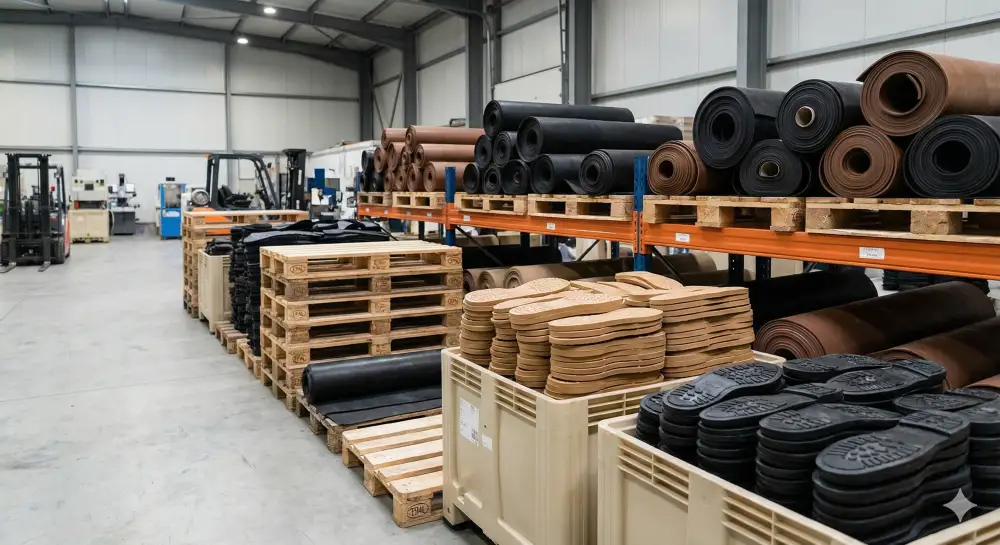
For footwear brands managing global supply chains, switching or onboarding a component manufacturer is a high-stakes decision. In the footwear industry, a supplier’s failure doesn’t just manifest as a late shipment; it shows up as widespread product delamination, critical chemical compliance failures, or outsoles that fail standardized abrasion tests in the middle of a retail season.
To protect your brand’s margins and market reputation, procurement teams must look beyond piece-rate pricing. Evaluating a supplier requires a hard, technical look at their chemical handling capabilities, mechanical testing infrastructure, and engineering transparency.
This procurement checklist details the non-negotiable operational and technical pillars your next footwear component supplier must satisfy before you sign a master services agreement.
1. Raw Material Traceability and Compounding Control
The foundation of a flawless outsole or midsole is compound consistency. If a supplier cannot guarantee the exact molecular breakdown of their inputs shift over shift, your final product will suffer from inconsistent density, hardness, and performance.
What to Audit
- Polymer Verification: Does the factory test incoming raw polymers (like pure EVA resins or synthetic rubbers) for density and purity, or do they rely solely on the raw material broker’s certificate of analysis (CoA)?
- MDR Rheometer Tracking: A premium supplier will run Moving Die Rheometer (MDR) curves on every single compound batch before it hits the molding floor. This data confirms the exact optimum cure time (t90) and cross-linking density, ensuring the elastomer will not arrive brittle or under-cured.
- Filler Ratios: Ensure the factory has automated dosing systems for fillers like calcium carbonate. Manual compounding leads to “over-filling,” which slashes production costs for the supplier but severely ruins the sole’s flex life and slip resistance.
2. In-House Laboratory and Mechanical Testing Infrastructure
Never trust a component supplier that relies entirely on external third-party labs for their routine quality control. By the time a third-party lab flags a failure, weeks of defective inventory may have already been molded, packaged, and shipped.
Non-Negotiable Lab Equipment Checklist
Your supplier’s factory floor or internal QA lab should be actively running the following standardized tests:
- DIN Abrasion Tester (ISO 4649): To verify volume loss metrics on outsoles. For a breakdown of how different compound profiles behave under this specific test, refer to our guide on Sole Performance Trade-offs.
- SATRA TM92 / Ross Flexing Machines (ASTM D1052): To run continuous flex fatigue cycles on the forefoot flex zones. This equipment is mandatory for verifying components subjected to extreme movement, such as TPR fore parts If a manufacturer lowers compound density to pass aggressive flex-fatigue tests such as the SATRA TM92 or Ross Flexing Test (ASTM D1052) the material loses its mechanical resistance to tearing and puncturing. Under abrasive friction, the cells pull apart easily, causing the sole to wear flat in weeks.
- Durometer Stations: Digital Shore A (for rubber/TPR) and Asker C (for EVA/PU foams) testing equipment must be calibrated daily to check hardness consistency at the beginning, middle, and end of every single shift. For assistance choosing the correct metric for your tech pack, review our Shore A Hardness Guide.
3. Vertically Integrated Manufacturing Capabilities
Fragmented supply chains introduce major lead-time friction and massive finger-pointing when a defect occurs. If Supplier A mixes the compound, Supplier B injection-molds the part, and Supplier C applies the primer, tracking down the root cause of a field failure becomes impossible.
The Operational Breakdown
- The Fragmented Model: [Compound Mixer] ➔ [Molding Factory] ➔ [Priming Workshop] = High risk, split accountability.
- The Vertically Integrated Model: [In-House Compounding + In-House Molding + In-House QA] = Single-source accountability.
The Procurement Advantage
Choosing a vertically integrated manufacturer drastically compresses your production lead times. It grants your brand single-source accountability. If an issue like a poor compression set occurs, one engineering team owns the problem, identifies the chemical root cause in the mixing phase, and rectifies it on the molding line immediately. You can see how this vertical harmony influences component selection in our breakdown of Rubber Blockers vs. Rubber Soles vs. Rubber Sheets.
4. Chemical Compliance and Environmental Certifications
A single restricted substance finding can cause customs seizures, massive retail recalls, and irreversible brand damage. Your component supplier must maintain an active, proactive stance on chemical safety.
- REACH & RoHS Compliant: Guarantees components are free from heavy metals, restricted phthalates, and harmful plasticizers common in low-tier rubber lines.
- ZDHC (Zero Discharge of Hazardous Chemicals): Proves the factory safely manages chemical effluents and manufacturing waste, protecting your brand’s ESG metrics.
- SATRA Membership: Indicates the factory aligns its internal QC testing protocols with the absolute highest international standards for footwear engineering.
The Sourcing Director’s Go/No-Go Scorecard
When completing your final factory audit, use this quick checklist to determine if a supplier qualifies for mass production:
- Automated Compounding: Compound weighing and mixing are computer-controlled to eliminate human error.
- Dyne Testing Prep: The factory validates the surface energy of outsoles (target: >42 dynes/cm) before applying assembly primers.
- Traceability: Every crate of finished outsoles carries a batch code linking it directly back to the specific raw polymer lot and rheometer shift data.
- Tooling Ownership Clarity: The supplier provides transparent engineering drawings and clear mold maintenance schedules for your proprietary outsoles.
By auditing these specific metrics, product managers can confidently step away from high-risk suppliers and partner with an engineering firm capable of safeguarding their brand’s margins. To see how optimizing these backend manufacturing parameters translates to superior performance on the retail floor, see our evaluation of EVA vs. Rubber vs. TPR Footbeds.
Frequently Asked Questions (FAQ)
Why should a procurement manager prioritize a supplier with automated compounding systems?
Manual compounding relies on factory operators manually scooping chemical powders, fillers, and vulcanization accelerators into a scale. A variation of just a few grams can completely throw off a rubber compound’s cross-linking matrix or density. Automated systems eliminate human error, ensuring that every production lot matches the exact physical properties approved during prototyping.
What is the risk of onboarding a footwear component supplier that lacks an MDR Rheometer?
Without a Moving Die Rheometer (MDR), a factory is essentially guessing their baking and vulcanization times. They run the risk of under-curing the elastomer (leaving the sole soft, under-bonded, and prone to extreme abrasion) or over-curing it (making the material brittle and prone to cracking). MDR curves provide an exact, data-driven map of polymer cross-linking during production.
How does a supplier’s internal tooling and mold-making capability impact lead times?
When a supplier outsources their mold engineering to a separate tool shop, any mid-production modification, design adjustment, or mold wear repair can stall production for weeks. An in-house tooling division allows engineers to modify design paths, service vents, and clean flashing gates immediately, keeping your sample-to-mass-production timeline moving without delays.
Why is a supplier’s verification of Dyne levels critical for a footwear brand?
Dyne levels measure the surface energy and chemical wetting capacity of a material. If an EVA or rubber outsole leaves the factory floor with a Dyne level below 42 dynes/cm, adhesives cannot form a deep mechanical or chemical bond with the upper. A supplier who actively verifies these metrics guarantees that their components are chemically primed and ready for fail-safe final bonding.
If you need any other content pieces generated for this project, just paste the topic or target keywords here and I will give you the ready-to-use copy immediately in our chat window!