

Blog
Common Footwear Soling Defects and How Quality Control Prevents Them

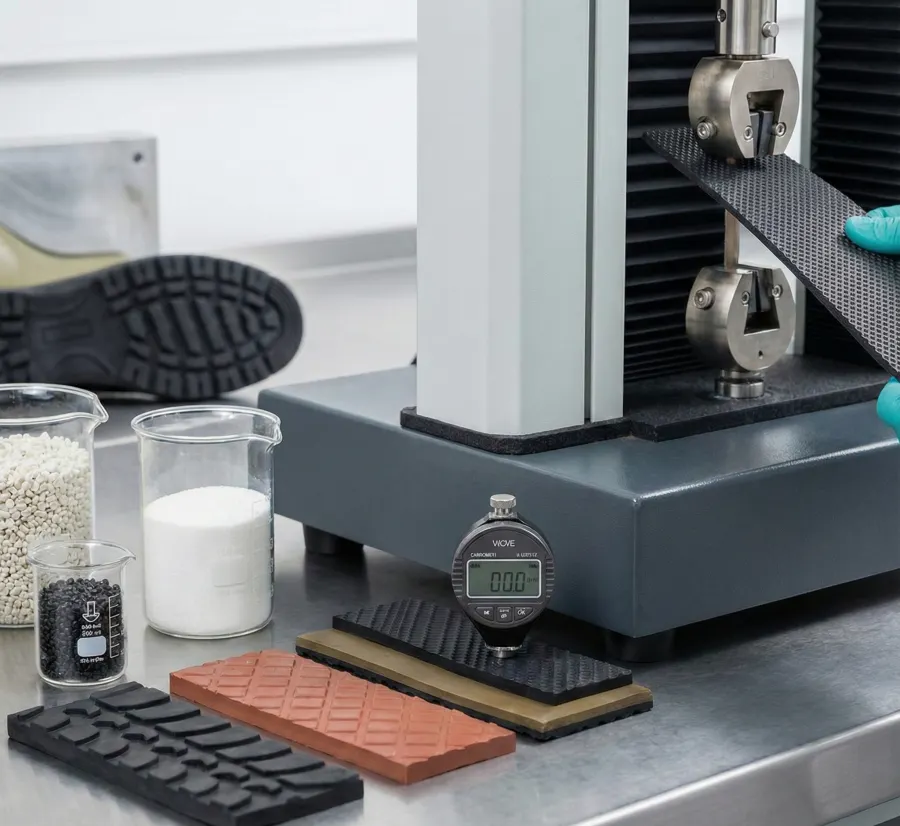
In high-volume footwear manufacturing, the soling assembly is the most critical point of structural failure. For product managers and procurement teams sourcing components globally, a field failure rate exceeding a fraction of a percent can devastate a brand’s reputation and lead to costly returns, chargebacks, or severed retailer relationships.
Preventing these issues requires moving past simple visual inspections. True quality control (QC) demands a rigorous, metrics-driven approach at every stage—from compound mixing and molding to final bonding. Sourcing your components from a single, vertically integrated manufacturer can streamline this process and drastically reduce overall lead times while maintaining tight quality safeguards.
Below, we break down the most common physical and structural defects found in rubber, EVA, and polyurethane (PU) outsoles, their technical root causes, and the specific QC protocols required to eliminate them before they leave the factory floor.
1. Delamination and Sole Separation
The Defect: The outsole cleanly separates from the midsole or the upper, typically starting at high-stress pivot points like the toe box flex zone or the medial arch.
The Root Cause
Bonding failure rarely stems from a “bad batch of glue.” It is almost always a failure of surface preparation or chemical compatibility.
- Inadequate Buffing: If the bonding surface of a rubber or EVA sole is not properly textured, the adhesive cannot form a mechanical lock.
- Improper Priming: Materials like thermoplastic rubber (TPR) and vulcanized rubber require specific chemical primers (like halogenation agents) to alter surface energy. Skipping or rushing this step prevents the adhesive from cross-linking. Understanding the nuances of Rubber Blockers vs Rubber Soles vs Rubber Sheets is vital here, as different form factors require highly specific preparation steps.
- Migration of Plasticizers: In low-grade PVC or rubber compounds, oils and plasticizers can migrate to the surface over time, forming a greasy barrier that degrades the adhesive bond post-production.
The QC Prevention Protocol
- Green Tack & Peel Strength Testing (ASTM D903): Representative samples from every production lot must undergo laboratory peel testing. A standard B2B benchmark for high-quality performance footwear is a minimum peel strength of 3.5 to 4.0 kg/cm.
- Surface Tension Verification: Utilizing Dyne test pens on the factory floor ensures that prepared soling surfaces have reached the critical surface energy threshold (typically greater than 42 dynes/cm) required for optimal adhesive wetting.
2. Excessive Micro-Cracking and Flex Fatigue Failures
The Defect: Deep cracks develop across the flex lines of the outsole after brief consumer wear. In severe cases, the outsole splits entirely in half along the ball of the foot.
The Root Cause
This is a material compounding issue disguised as a wear-and-tear problem.
- Over-Filling: To reduce material costs, some manufacturers over-saturate rubber compounds with cheap fillers like calcium carbonate or clay. While this maintains weight and hardness, it severely compromises the elastomer’s tensile strength and elongation metrics.
- Under-Curing: If the mold temperature or cycle time is cut short to speed up production output, the polymer chains fail to fully cross-link, leaving the material brittle.
The QC Prevention Protocol
- SATRA TM92 or Ross Flexing Test (ASTM D1052): Randomly selected outsoles must be subjected to mechanized flex testing. High-performance rubber outsoles should comfortably withstand 50,000 to 100,000 flex cycles at room temperature without showing a crack growth greater than 2.0 mm.
- Rheometer Curve Monitoring: Engineers must check moving die rheometer (MDR) data for every compound batch to ensure the exact optimum cure time (t90) is reached during vulcanization. When engineering components like TPR fore parts, tracking these curves is mandatory to protect the high-flex forefoot zone from premature fatigue failure.
3. High Abrasion Wear (Premature Balding)
The Defect: The tread pattern, lugs, or grip textures wear down completely within weeks of use, turning a rugged utility or athletic sole into a smooth, hazardous surface.
The Root Cause
- Incorrect Polymer Blend: Utilizing high-elasticity polymers without balancing them with high-molecular-weight rubbers (like Polybutadiene Rubber or PBR) that resist shearing forces.
- Density Variances in Compressed EVA: Injected or compression-molded EVA soles that drop below target density specs to save weight often sacrifice structural density, leaving the cell walls prone to rapid tearing under abrasive friction.
The QC Prevention Protocol
- DIN Abrasion Resistance Testing (ISO 4649 / ASTM D5963): This is the definitive metric for soling durability. A cylindrical sample is rotated against a specific grade of abrasive paper under fixed pressure.
- Standard Work/Utility Spec: Material volume loss must be restricted to less than 150 mm³.
- Premium Athletic/Tactical Spec: Material volume loss must be restricted to less than 120 mm³.
4. Compression Set (Sole Flattening and Hardening)
The Defect: The cushioning midsole or outsole compresses under the wearer’s weight but fails to rebound. The shoe permanently loses its shock absorption, becomes thin, and feels hard to the wearer.
The Root Cause
This is the single most common defect in low-tier EVA and PU midsoles.
- Poor Gas Retention or Closed-Cell Collapse: In molded EVA, if the blowing agents are inconsistent or the cooling cycle is uncalibrated, the microscopic cells collapse under sustained load.
- Isocyanate/Polyol Imbalance: In PU formulation, a slight deviation in the chemical ratio alters the cellular matrix, ruining the material’s inherent memory and elasticity.
The QC Prevention Protocol
- Compression Set Testing (ASTM D395 Method B): Soling foam samples are compressed to 25% of their original thickness, subjected to a specific temperature (typically 50°C) for 22 hours, and allowed to recover. Premium-grade EVA components must maintain a compression set below 35%, while elite-tier compounds track closer to 20-25%. This is a vital metric to analyze when selecting a base formulation, as outlined in our comprehensive guide comparing EVA vs Rubber vs Cork Footbeds.
- Constant Durometer Audits: Shore A (for hard rubber) and Shore Asker C (for soft foams/EVA) hardness testing must be conducted at the beginning, middle, and end of every production shift to guarantee consistency across the entire production run. If you are unsure about which scale to deploy for a specific compound, refer to our structural Shore A hardness guide.
The Weston Rubber Blueprint: Proactive QA Over Reactive Inspection
Catching defects on the finished shoe is an expensive failure model. True quality assurance in footwear component manufacturing happens at the chemical and raw material stage.
| Manufacturing Phase | QC Checkpoint Metric | Target Benchmark |
|---|---|---|
| Compounding | Specific Gravity & Rheometer Testing | ±0.02 g/cm³ deviation max |
| Molding | Shore Hardness (Asker C / Shore A) | ±3 points variance tolerance |
| Post-Molding | DIN Abrasion Volume Loss | Less than 120-150 mm³ |
| Assembly Prep | Dyne Surface Energy Testing | Greater than 42 dynes/cm |
| Final Assembly | SATRA Peel Strength Testing | Min 3.5 kg/cm |
By enforcing strict limits on raw polymers, maintaining precise control over mold parameters, and demanding verified laboratory testing before components leave the factory, brands can completely eliminate field delamination and premature wear. To map out which base materials minimize these variables for your specific footwear brief, read our breakdown on EVA vs Rubber vs TPR.
Frequently Asked Questions (FAQ)
Can you bond an EVA midsole to a traditional rubber outsole without experiencing field delamination?
Yes, but it requires highly rigid surface preparation. Because EVA has a non-porous, closed-cell structure, the surface must either be mechanically buffed (roughened) or treated with an appropriate chemical primer to elevate its surface energy. In standard manufacturing setups, a Dyne pen reading below 42 dynes/cm indicates insufficient wetting, which will cause immediate bonding failure under regular flex cycles.
Why do rubber outsoles sometimes suffer from micro-cracking across the toe box flex lines?
This failure typically points to an unbalanced compound formula where the manufacturer has “over-filled” the natural or synthetic rubber matrix with cheap minerals (like calcium carbonate) to decrease production costs. While this practice maintains weight, it degrades the elastomer’s tensile strength, resulting in brittle structural properties that split under continuous mechanical strain.
How does the DIN abrasion test protect brands from customer warranty returns?
The DIN abrasion resistance test (ISO 4649) functions as a stress simulator by measuring the exact volumetric material loss (in cubic millimeters) when a rubber or elastomer sample is subjected to aggressive frictional forces. By mandating that utility work boot soles lose less than 150 mm³ and athletic soles lose less than 120 mm³, footwear brands can analytically filter out low-density compounds that would otherwise “bald” quickly in active use environments.
What causes a premium foam midsole to permanently flatten or harden after brief wear?
This structural defect is known as a high compression set. It occurs during the chemical foaming stage when blowing agents are poorly mixed, or when the mold’s cooling cycle is cut short. This compromises the microscopic gas-retention cells within materials like compressed EVA or Polyurethane (PU), causing them to permanently collapse under the weight of the wearer rather than rebounding back to their original profile.