

Blog
What Is Performa Sheet? Lightweight Rubber-EVA Soling Material Explained for Footwear Manufacturers

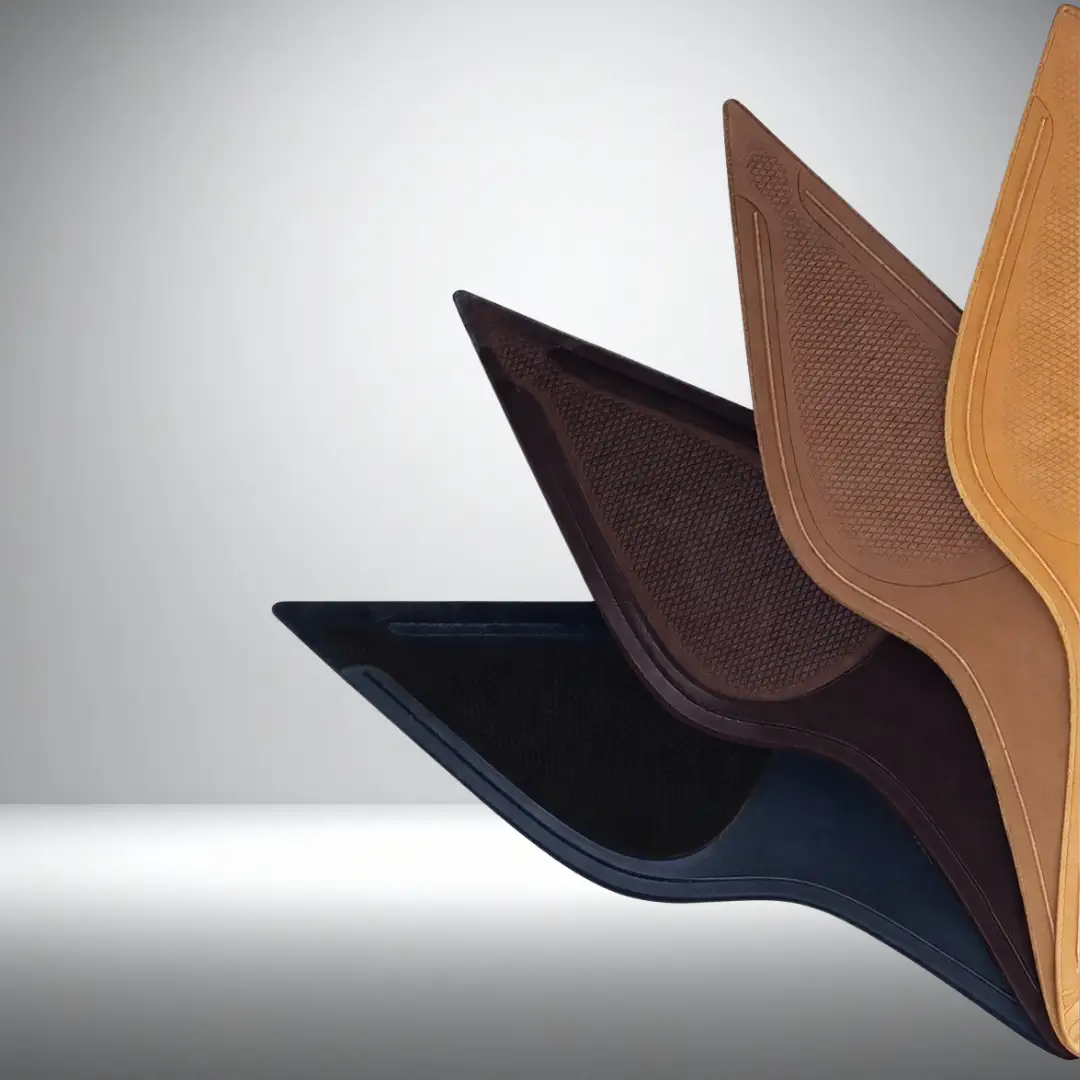
There is a specification gap in footwear manufacturing that standard materials don’t resolve cleanly. Standard rubber sole sheets deliver the durability and abrasion performance outsoles require — but they add weight that isn’t always compatible with the product brief. EVA sheets offer low weight and cushioning but cannot match rubber’s abrasion performance for outsole applications where wear resistance matters. Performa sheet was developed to close that gap: a rubber-EVA compound hybrid that delivers abrasion performance at the rubber benchmark, at significantly lower weight than solid rubber sheets.
If you’ve encountered this product as “Tunit sheet” or “lightweight rubber sole sheet,” you’re looking at the same material category — all three names are used across the Indian and South Asian footwear industry for what is, in practice, the same rubber-EVA compound construction. This guide explains what the material is, why it performs the way it does, the two grade options available, and where it is most commonly specified in footwear production. Weston Rubber’s Performa / Tunit sheet is available in both grades, in any colour, with confirmed abrasion performance below 150 cubic millimetres.
Performa Sheet, Tunit Sheet, Lightweight Rubber Sheet: Clearing Up the Naming
The naming confusion around this product category is the first thing most buyers need resolved before they can specify accurately. Three names are in common use, and they describe the same product:
- “Performa sheet” — the trade name used by Weston Rubber Industries and widely used in the Indian footwear manufacturing industry; a registered product name for the rubber-EVA compound sheet range.
- “Tunit sheet” — the same product category under a different trade name, more commonly used in formal and dress footwear sourcing circles, particularly in markets specifying stitchdown and welt constructions. Some buyers use “Tunit” specifically for the snuff/nubuck finish variant, which is the only surface finish this product is available in.
- “Lightweight rubber sole sheet” — a generic descriptive term used by buyers who know the performance category (lighter than standard rubber, more durable than EVA) but don’t have a specific trade name to reference.
What unites all three names is the same material construction: a compound of natural or synthetic rubber blended with EVA, engineered to achieve rubber-grade abrasion performance at a density and weight significantly below standard solid rubber sheets. Weston lists all three variants under a single product entry. Wherever you encounter any of these names in a specification or quotation request, the product being described is the same.
What Is Performa Sheet? Composition, Construction and What Makes It Different
Performa sheets are flat sheets manufactured from natural rubber or synthetic rubber compounds — which may include EPDM, Neoprene, Nitrile (NBR), Silicone, or SBR — combined with EVA through a controlled moulding process that produces uniform thickness, density, and surface finish across the full sheet.
The rubber-EVA combination is what distinguishes this material from both of its nearest alternatives. A standard rubber sole sheet is solid rubber throughout — high mechanical strength and abrasion resistance, but the highest density of any soling sheet material. A standard EVA sheet is expanded foam — lowest density, best cushioning performance, but significantly lower abrasion resistance for outsole applications. Performa sheet sits between them by design: the rubber compound contributes the abrasion resistance, mechanical strength, and outsole durability; the EVA component reduces the overall density to produce a sheet that is substantially lighter than solid rubber while retaining the abrasion performance that EVA alone cannot achieve.
Two grades are available, both measured in Shore A — the correct hardness scale for solid-compound rubber and rubber-EVA hybrid materials:
- Flexible grade: Shore A 80 ±3 — for applications requiring forefoot flex; bends under stride without cracking or delaminating.
- Normal grade: Shore A 90 ±3 — harder-wearing specification for heel toplifts and full outsoles where maximum surface durability is the priority.
Standard sheet size is 25″ × 35″. Surface finish is snuff/nubuck only — a textured, suede-like finish that is standard for formal and dress footwear outsole applications and well-suited to stitchdown and welt constructions. Any colour can be manufactured; there is no colour limitation.
Key Properties of Performa / Tunit Sheet — Translated for Footwear Performance
The table below translates each material property into its footwear outcome. The abrasion figure — below 150 cubic millimetres at 10N load — is the article’s most important data point and deserves particular attention: it is the same performance benchmark used for standard rubber sole sheets and heel toplift applications, achieved here in a material that weighs significantly less.
| Performa / Tunit Sheet Property | What It Delivers in Footwear |
| Extremely lightweight | Significantly lower weight per sq metre than standard rubber — weight-reduction brief met without sacrificing durability |
| Abrasion <150 cu mm at 10N load | Industry-leading abrasion performance for a lightweight sheet; matches standard rubber sheet benchmark despite lower density |
| Shore A 80 ±3 (Flexible grade) | Suitable for forefoot flex zones; bends without cracking under repeated stress cycles |
| Shore A 90 ±3 (Normal grade) | Harder-wearing specification for heel toplifts and full outsoles requiring maximum surface durability |
| Shock absorption & vibration damping | Comfort advantage over solid rubber — the EVA component contributes cushioning without compromising structural integrity |
| Good tensile strength & elongation | Long service life under repeated compression and bending — neither rubber nor EVA component fails under sustained wear |
| Snuff/nubuck surface finish | Premium textured finish suited to formal, dress, stitchdown, and welt footwear; consistent across all colours |
| Full colour customisation | No colour limitation — any required colour available; supports branded and fashion-forward sole designs |
The abrasion figure warrants a direct statement: Weston’s product page describes it as “unmatchable with any other outsole material available in the industry” for a lightweight sheet specification. Whether that claim is evaluated against EVA foam outsoles (which typically measure significantly above 150 cu mm), TPR outsoles (which vary widely by compound), or other lightweight rubber-compound composites, it represents a meaningful performance claim — one that is verifiable against standard DIN abrasion testing and directly comparable to the ≤150 cu mm benchmark cited for Weston’s rubber top lifts sheets. For buyers specifying heel and outsole durability in the same brief, Performa sheet achieves that benchmark at lower weight.
Performa Sheet vs Standard Rubber Sheet vs EVA Sheet: Where It Fits
The comparison below positions Performa/Tunit sheet in the context of the two materials buyers most frequently evaluate alongside it. The decision line is straightforward once the three are laid out side by side.
| Criterion | Performa / Tunit Sheet | Standard Rubber Sheet | EVA Sheet |
| Weight | Lightest (rubber-EVA hybrid) | Heaviest (solid rubber) | Lighter than rubber; heavier than EVA foam |
| Abrasion | <150 cu mm at 10N load | <150 cu mm (standard rubber) | Much higher (lower abrasion performance) |
| Shore A / Asker C | 80A (flex) or 90A (normal) | Multiple Shore A grades | Asker C (different scale — not Shore A) |
| Surface finish | Snuff/nubuck only | Multiple textures available | Multiple textures available |
| Colour | Any colour | Any colour | Any colour |
| Applications | Outsoles, toplifts, stitchdown, welts, midsoles | Outsoles, heels, safety, repair | Midsoles, sandals, flat casual soles |
| Best for | Formal/dress needing light weight + durability | Heavy-duty, safety, outdoor | Cushioning-first applications |
| Decision guide: when to specify Performa / Tunit sheetSpecify Performa/Tunit sheet when your brief requires outsole or toplift durability at the rubber performance benchmark, but the product weight specification or category positioning makes standard solid rubber sheets unsuitable. The snuff/nubuck finish is a natural fit for formal, heritage, and dress footwear categories. For applications requiring different surface textures or very high-load outdoor durability, standard rubber sole sheets remain the stronger specification. |
For deeper guidance on standard rubber sole sheets, see: Rubber Sole Sheets Explained. For EVA sheet properties and Asker C hardness, see: What Are EVA Sheets?. For the Shore A vs Asker C hardness scale distinction, see: What Is Shore A Hardness?
Footwear Applications: Where Performa / Tunit Sheet Is Specified
Performa/Tunit sheet has a broader application range than any other single Weston sheet product — confirmed for five distinct footwear applications across the sole construction. Each is worth addressing individually because the buyer type and specification context differs between them.
Outsoles
The primary application — a full outsole specification for formal, casual, and lifestyle footwear where standard rubber is heavier than the brief requires. The 90A normal grade is the standard outsole specification; the 80A flexible grade suits constructions where the outsole needs to flex with the foot rather than remain rigid underfoot. Die cutting is the most common production method for volume outsole production from Performa sheets.
Toplifts
Heel toplift components benefit particularly from Performa sheet’s combination of abrasion performance and lower weight. The 90A normal grade is the standard toplift specification. For formal footwear where the heel is a visible quality signal, the snuff/nubuck finish is appropriate and consistent with the material’s aesthetic positioning. The confirmed abrasion below 150 cu mm at 10N load means Performa toplift components meet the same wear resistance benchmark as standard rubber toplift sheets.
Stitchdown construction
Stitchdown is a construction method in which the upper material is turned outward and stitched directly to the outsole — common in formal, heritage, and artisan footwear. Performa sheet’s flexibility and consistent surface finish make it particularly well-suited to this construction: the 80A flexible grade bends cleanly at the stitch line without cracking, and the snuff/nubuck surface is aesthetically aligned with the formal categories where stitchdown is used.
Welt construction
Goodyear welt and related constructions use a strip of material (the welt) to join the upper and outsole. Performa sheet is applicable as an outsole in welt-constructed shoes — the snuff/nubuck finish is appropriate for the formal footwear categories that typically use welt construction, and the material’s durability profile is consistent with the long-life expectations built into welt-constructed footwear.
Midsoles
The 80A flexible grade can serve as a midsole in constructions that require a harder rubber-compound midsole equivalent without going to full solid rubber. This is a less common application than outsoles and toplifts but relevant for specific formal and safety constructions where a rubber-grade compound midsole is part of the specification.
Processing Performa / Tunit Sheets: Compatible Manufacturing Methods
Performa sheets are engineered to be highly adaptable in production. Four processing methods are confirmed, including laser cutting — which is a meaningful differentiator from standard solid rubber sheets, where the material’s high density and composition make laser processing less effective.
- Die cutting: the standard high-volume method; fastest cycle time for consistent-geometry outsole and toplift production at scale. Performa sheet’s compound uniformity ensures predictable cut quality and low reject rates across large production runs.
- Laser cutting: available with Performa sheet due to the EVA component in the compound — the reduced density compared to solid rubber improves laser energy absorption and cut quality. Enables intricate profiles, tight tolerances, and premium designs that die cutting cannot produce. Not standard on solid rubber sole sheets.
- CNC routing: precision profiling for complex geometries, custom sole designs, and orthopaedic applications. Consistent hardness across the sheet supports CNC processing without material variance affecting dimensional accuracy.
- Manual fabrication: suited to small-batch, bespoke, and repair operations. Consistent material properties support hand-cutting with predictable results and clean edges.
| Why the rubber-EVA compound aids processingThe EVA component in Performa sheet reduces the overall compound density compared to solid rubber, making all four cutting methods more efficient than equivalent operations on standard rubber sole sheets. Blade wear is reduced in die cutting; laser energy absorption is improved; CNC routing produces cleaner edges. For production teams switching from standard rubber sheets to Performa, the processing efficiency improvement is a direct operational benefit alongside the weight reduction. |
Sourcing Performa / Tunit Sheets: What to Look for and Why Weston Rubber Delivers It
Performa/Tunit sheet is a specialist product category with fewer manufacturers than standard rubber or EVA sheets. For procurement teams evaluating suppliers, the following checklist covers the specification requirements that should be confirmed before placing a volume order.
- Confirmed abrasion performance. The defining claim for this product category is abrasion below 150 cu mm at 10N load. This is a measurable, verifiable figure — not a marketing description. Weston’s product documentation confirms it explicitly. A supplier who cannot provide verified abrasion data for their Performa/Tunit sheet is providing an incomplete specification.
- Two Shore A grades available. The flexible (80A) and normal (90A) grades serve different application zones and cannot substitute for each other in precision specifications. A single-grade supplier constrains your specification to their inventory.
- Full colour capability. Performa sheet should be available in any required colour. Weston confirms no colour limitation — branded, fashion, and category-specific colour requirements are all supported.
- Standard sheet size confirmed. 25″ × 35″ is the standard size, relevant for cutting yield planning, nesting calculations, and inventory management.
- Processing compatibility verified. Die cutting, laser cutting, CNC routing, and manual fabrication are all supported. Production teams with existing equipment can integrate Performa sheets without workflow changes.
- In-house QC. Material testing, process monitoring, and pre-dispatch inspection are standard at Weston. Batch-to-batch compound consistency in Shore A value, density, and surface finish is verified before dispatch.
Full soling range context. Weston supplies Performa/Tunit sheets within a complete soling range — EVA, rubber, TPR, and cork. Multi-material briefs that include Performa sheets alongside other soling components are handled from one facility.
FAQs: Common Questions About Performa and Tunit Sheets
What is the difference between Performa sheet and Tunit sheet?
Performa sheet and Tunit sheet are two trade names for the same category of rubber-EVA compound lightweight soling sheet. Both describe a flat sheet manufactured from a rubber-EVA compound blend that delivers abrasion performance comparable to standard rubber sole sheets at significantly lower weight. The name “Performa” is more widely used in Indian footwear manufacturing; “Tunit” is more common in formal footwear sourcing and markets specifying stitchdown and welt constructions. Weston Rubber supplies both under a single product listing.
Is Performa sheet lighter than a standard rubber sole sheet?
Yes — significantly. The EVA component in the rubber-EVA compound reduces the overall density compared to solid rubber, making Performa sheet substantially lighter per square metre than a standard rubber sole sheet at equivalent thickness. The weight reduction is achieved without sacrificing abrasion performance: Weston’s Performa sheets achieve abrasion below 150 cubic millimetres at 10N load, which is the same benchmark cited for standard rubber toplift sheets. This combination — rubber-grade abrasion at lower weight — is the defining characteristic of the product category.
What Shore A hardness does Performa / Tunit sheet come in?
Weston’s Performa/Tunit sheets are available in two Shore A grades: 80 ±3 Shore A (flexible grade) and 90 ±3 Shore A (normal grade). Shore A is the correct hardness scale for this material — it is a solid rubber-EVA compound, not a foam, so Shore A applies rather than Asker C (which is the correct scale for EVA foam). The flexible grade suits forefoot flex applications and stitchdown constructions; the normal grade suits heel toplifts and full outsoles where maximum wear resistance is required.
Can Performa sheet be used for stitchdown and welt shoe constructions?
Yes — Performa sheet is confirmed for both stitchdown and welt constructions. The 80A flexible grade is particularly well-suited to stitchdown shoes, where the outsole must flex cleanly at the stitch line without cracking under repeated bending stress. The snuff/nubuck surface finish is aesthetically appropriate for the formal and heritage footwear categories that commonly use stitchdown and Goodyear welt constructions. Consistent compound uniformity across the sheet supports clean stitching edges and predictable adhesive bonding in both construction types.
Does Weston Rubber supply Performa / Tunit sheets in custom colours and grades?
Yes. Weston Rubber Industries supplies Performa/Tunit sheets in both the 80A flexible and 90A normal grades, in any required colour — there is no colour limitation. Standard sheet size is 25″ × 35″. Custom orders for specific colour, grade, or volume requirements are supported with in-house QC and pre-dispatch inspection across all batches. OEM and bulk supply orders are handled with reliable scheduling and secure packaging for transport to India and overseas destinations.
Conclusion
Performa sheet — whether you know it as Tunit sheet or lightweight rubber sole sheet — resolves a specification gap that standard materials don’t close: rubber-grade abrasion performance at lower weight, in a snuff/nubuck finish suited to formal and dress footwear categories. The two Shore A grades (80A flexible, 90A normal) cover the full range of outsole, toplift, stitchdown, welt, and midsole applications. The confirmed abrasion benchmark of below 150 cubic millimetres at 10N load means the performance claim is verifiable, not aspirational.
Weston Rubber Industries supplies Performa/Tunit sheets with in-house QC and full colour customisation, alongside the complete EVA, rubber, TPR, and cork soling range. Multi-material briefs that include Performa sheets are handled from one facility.