
Blog
Cork Material in Footwear: Properties, Benefits and Why Sustainable Brands Are Specifying It

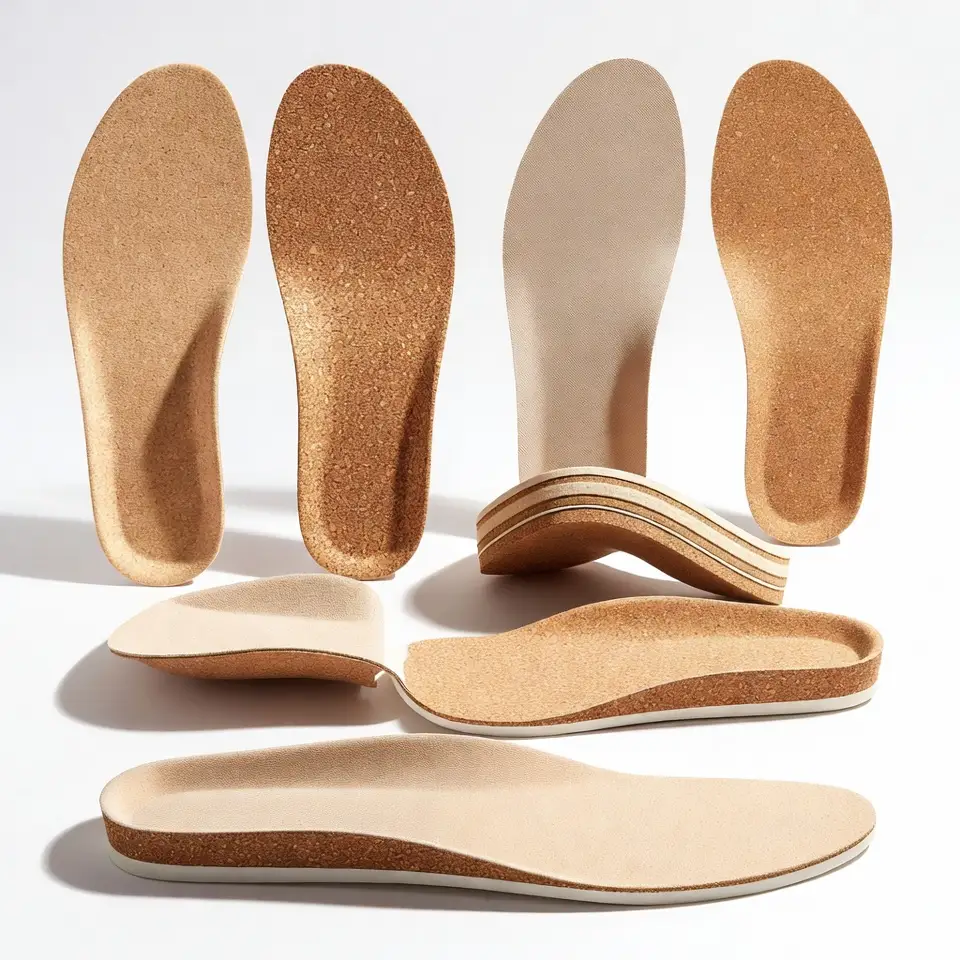
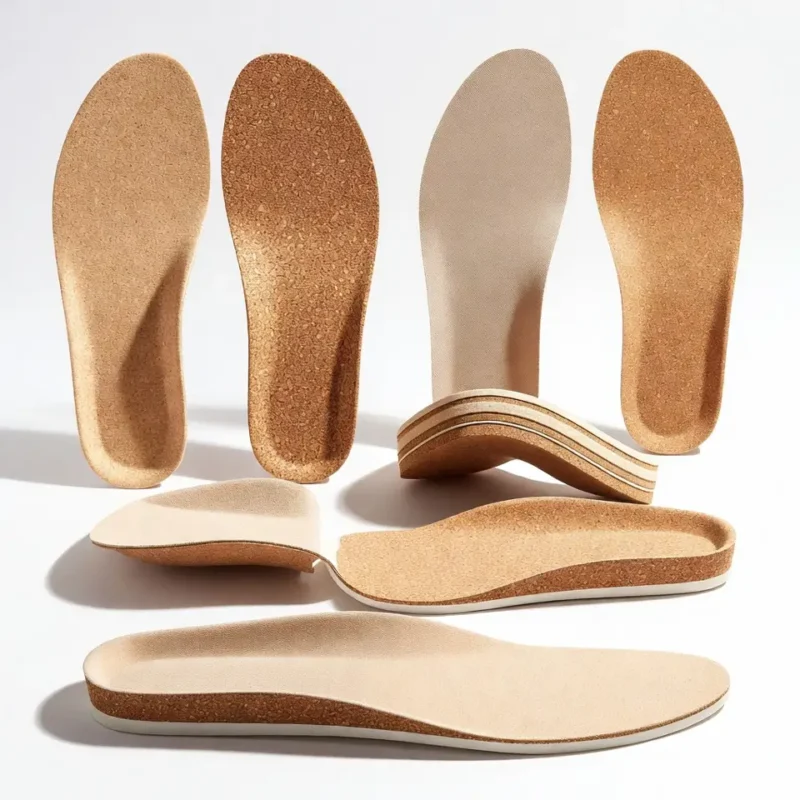
Cork is one of the oldest natural materials used in footwear — and one of the most strategically relevant for manufacturers navigating today’s sustainability requirements. As retail partners in Europe and North America increasingly ask for verifiable material credentials, cork’s combination of natural performance properties and a genuinely renewable supply chain makes it a material worth understanding properly, whether you’re specifying a footbed component or building a sustainability story behind your product range.
This guide covers both the material science and the commercial case for cork in footwear. You’ll find a full breakdown of cork’s properties and what they mean for footwear performance, a clear distinction between cork footbeds and cork sheets (the two product forms most relevant to manufacturing), the environmental credentials that make cork a credible sustainability specification, and a comparison with EVA and rubber to help you position it accurately in your brief. To see the full range, Weston Rubber’s cork footbeds and cork sheets are manufactured and supplied from a single facility in India.
What Is Cork Material? Origin, Structure and How It’s Harvested
Cork is the outer bark of the cork oak tree, Quercus suber, harvested primarily in Portugal, Spain, and North Africa. The key distinction from most other natural materials is how it is obtained: the bark is stripped from the living tree by hand, without felling it. The tree is left intact, the bark regenerates over the next nine to twelve years, and the cycle continues. A single cork oak can be harvested twenty times or more across its lifespan of 150 to 200 years. This is not a forestry process that consumes the resource — it is one of the rare cases where commercial harvesting actively incentivises the preservation of natural forest.
At the cellular level, cork is composed of millions of microscopic, air-filled cells — approximately 40 million per cubic centimetre — each sealed and independent. This honeycomb-like structure is what gives cork its defining combination of properties: it is light because it is mostly air; it compresses and recovers because the cell walls are elastic; it insulates because trapped air is a poor conductor of heat; and it resists moisture because the cell walls are coated with suberin, a naturally hydrophobic compound.
Converting raw bark into footwear components involves boiling and drying the harvested bark, grinding it into granules, then blending those granules with a polymer binder — natural rubber, SBR, or EVA, at ratios typically ranging from 1:1 to 1:4 depending on the required density and flexibility. The blended material is formed into blocks through vulcanization under heat (135–140°C) and pressure for a minimum of 30 minutes, then cooled, cut to the required thickness, shaped using moulds or CNC tools, and optionally laminated to fabric or EVA bases. The result is a dimensionally stable, consistent material that retains all of cork’s natural functional properties while meeting the precision requirements of industrial footwear production.
Key Properties of Cork — Why It Performs in Footwear
The table below translates cork’s material properties into footwear performance outcomes. This is the language that matters at the brief stage — not cellular biology, but what the material does for the person wearing the shoe and the manufacturer producing it.
| Cork Property | What It Delivers in Footwear |
| Superior shock absorption | Reduces impact stress on feet and joints — essential for comfort and orthopaedic footwear |
| High compressibility with recovery | Moulds to the foot over time; retains shape after repeated compression; longer product life |
| Lightweight resilience | Reduces shoe weight without sacrificing underfoot support; less foot fatigue in extended wear |
| Natural thermal regulation | Keeps feet cool in summer, warm in winter — insulating in both directions without trapping heat |
| Moisture wicking | Draws moisture away from the foot surface; supports hygiene and comfort in extended wear |
| Antimicrobial & odour resistance | Natural resistance to bacteria and fungal growth — odour control without chemical treatment |
| Mouldability | Personalises fit after heat exposure or wear; relevant for orthopaedic and custom footwear |
| Biodegradable & renewable | Decomposes naturally at end of life; supports verifiable brand sustainability claims |
Two properties deserve particular attention for procurement teams evaluating cork against synthetic alternatives. The first is mouldability: cork footbeds personalise to the individual foot over time, conforming to the unique pressure distribution of the wearer. This is a performance characteristic no synthetic foam can replicate and it creates a compelling end-user story for brands in the comfort and premium segments. The second is natural antimicrobial performance: cork’s odour resistance and resistance to bacterial and fungal growth are intrinsic to the material — they don’t require chemical treatment, which matters both for product safety credentials and for the simplicity of the manufacturing process.
Cork Footbeds vs Cork Sheets: Which Product Form Do You Need?
Cork is available in two distinct product forms for footwear manufacturing, and they serve fundamentally different buyers at different stages of production. Using the wrong form for your workflow doesn’t just create processing inefficiency — it can cause specification errors and unnecessary cost. The table below clarifies the distinction.
| Criteria | Cork Footbeds | Cork Sheets |
| Form | Finished, ready-to-assemble component | Semi-finished raw material sheet |
| Product type | Normal grade or BS grade | Natural or composite; 3mm–8mm thickness |
| Normal grade | Rubber blended, buffed finish — economical | — |
| BS grade | Latex blended, premium textured finish — lightweight | — |
| Sizes (footbed) | Ladies 35–42 (5 designs); Gents 39–46, Kids 18–42 (2 designs) | Custom cut to spec |
| Thickness | 4–5mm (standard footbed construction) | 3mm–8mm standard; tapered to 6mm available |
| Customisation | Size and grade selection | Length, thickness, taper — full customisation |
| Best for | Brands needing ready-to-use footbed component | OEM manufacturers cutting/laminating their own |
| Processing | No further processing required | Die cutting, CNC, slitting, lamination |
Cork Footbeds
Weston’s cork footbeds are finished, ready-to-assemble components — the complete footbed, shaped, sized, and ready for insertion or bonding into the shoe. Two quality grades are available. The Normal grade is rubber-blended with a buffed surface finish — the economical specification for volume production where a clean, functional footbed is required. The BS grade is latex-blended with a premium textured finish — lighter, with a more refined feel and surface quality suited to premium and branded footwear ranges. Weston supplies ladies footbeds in five designs across sizes 35–42, and gents and kids footbeds in two designs across sizes 39–46 and 18–42 respectively.
Cork Sheets
Weston’s cork sheets are semi-finished raw material supplied as flat sheets for cutting, laminating, or moulding into custom components. Standard thicknesses run from 3mm to 8mm, with tapered profiles available — length and thickness (up to 6mm) can be customised, making them directly applicable to dutch and wedge sole constructions where a flat sheet doesn’t match the geometry. Cork sheets are compatible with die cutting, CNC routing, slitting, lamination, and adhesive bonding. Their consistent density across the sheet surface supports tight tolerances and predictable processing behaviour at scale.
| Which form is right for your production?If your production requires a ready-to-use footbed component in defined sizes and grades, specify cork footbeds. If you are cutting, laminating, or moulding your own footbed or insole components — or need a specific profile or dimension not covered by standard footbed sizes — specify cork sheets. Weston supplies both, and can advise on the right specification for your construction. |
The Environmental Case for Cork: Sustainability Credentials That Are Verifiable
The sustainability case for cork is one of the strongest available to footwear manufacturers — and, crucially, it is verifiable. In a market where sustainability claims are increasingly scrutinised by retail partners, trade press, and consumers, materials with credible, science-backed environmental credentials are a commercial advantage. Cork meets that standard.
- Renewable raw material with a regenerative harvest cycle. Cork bark is harvested every nine to twelve years without harming the tree. The bark grows back fully, and the cycle continues for the life of the tree — up to two centuries. No deforestation, no primary resource depletion. The commercial value of cork bark is the direct economic incentive that keeps cork oak forests standing.
- Carbon sequestration. Cork oak forests — known as montados in Portugal — are significant carbon sinks. After a harvest, a stripped tree absorbs three to five times more CO₂ than an unharvested tree, using the additional photosynthesis to fuel bark regeneration. The forests themselves sequester millions of tonnes of carbon annually, making cork production one of the few industrial material processes that actively contributes to atmospheric carbon removal.
- Carbon-negative potential. Cork products, including footbeds, can have a net-negative carbon footprint when responsibly sourced and manufactured. This is a verifiable claim — not marketing language — and it is the kind of material credential that holds up under supplier audit. Weston references cork’s carbon-negative potential directly in its product documentation.
- Biodegradable at end of life. Unlike EVA foam and most synthetic footbed materials, cork decomposes naturally. For brands in markets where end-of-life material responsibility is becoming a regulatory or retail requirement, biodegradability is a meaningful differentiator.
- Minimal processing footprint. Cork granule production uses offcuts and waste material from the cork stopper and construction industries — the footwear material supply chain operates largely on secondary processing of material that would otherwise be discarded. No primary resource extraction is required for granulated cork products.
- No synthetic chemicals for performance. Cork’s antimicrobial, moisture-wicking, and thermal properties are intrinsic to the material. They do not require chemical treatment, which simplifies the product safety documentation for brands targeting regulated markets.
| For brand and sustainability teamsCork’s environmental credentials are communicable in product marketing, supplier audits, and retail compliance documentation. Renewable sourcing, biodegradability, and carbon sequestration are all independently verifiable and not dependent on proprietary claims. For brands building a sustainable footwear range that can withstand scrutiny, cork is one of the most defensible material choices available. |
Cork vs EVA vs Rubber: Choosing the Right Footbed Material
Cork, EVA, and rubber each have a genuine case for use in footwear insoles and footbeds. The right choice depends on the brief — product category, price point, performance priority, and the sustainability credentials the brand needs to support. The table below provides an honest comparison across the variables that matter at the specification stage.
| Criterion | Cork | EVA | Rubber |
| Sustainability | Excellent — renewable, biodegradable, carbon-negative potential | Recyclable but synthetic | Natural but not recyclable post-vulcanization |
| Cushioning | Excellent + personalises to foot | Excellent, consistent | Low |
| Thermal regulation | Natural, both directions | Limited | Poor |
| Antimicrobial | Natural — no treatment needed | None without treatment | None |
| Weight | Lightweight | Lightest | Heaviest |
| Cost | Mid-to-premium | Lowest | Mid-to-high |
| Moulds to foot | Yes — over time | No | No |
Decision framework:
- If sustainability credentials, comfort personalisation, and premium product positioning are the priorities — cork is the specification. It is the only option in this set that is renewable, biodegradable, and naturally antimicrobial.
- If lightweight cushioning at high volume and the lowest cost-per-unit are the brief — EVA is the specification. It is the most processable and cost-efficient of the three for standard midsole and footbed applications.
- If durability, grip, and outdoor or safety performance define the product — rubber is the specification, particularly for outsole applications.
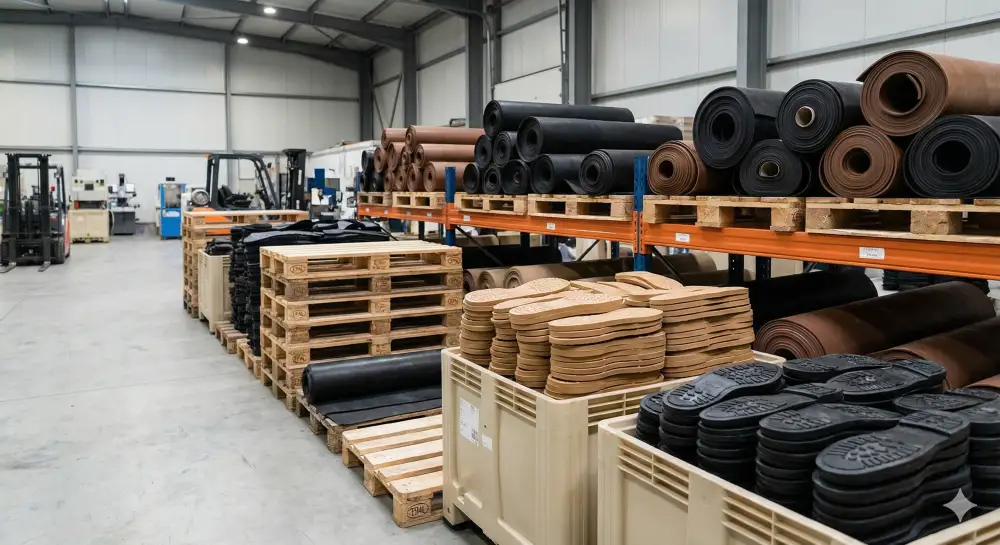
Worth noting: Weston Rubber Industries manufactures all three — cork, EVA, and rubber — from a single facility. For multi-material constructions (for example, a cork footbed paired with an EVA midsole and rubber outsole), sourcing from one supplier simplifies quality control, documentation, and lead-time management. See also: EVA sheets and soles and rubber soles and sheets.
Sourcing Cork Footbeds and Sheets: What Footwear Manufacturers Need from a Supplier
Cork is a precision sourcing decision — batch consistency, grade accuracy, and processing compatibility all affect the quality of the finished component. Here is what a procurement team should demand from a cork footbed and sheet supplier, and how Weston Rubber Industries delivers each requirement.
- Grade options for different price points and product tiers. Weston supplies cork footbeds in two grades: Normal (rubber-blended, economical, buffed finish) and BS (latex-blended, lightweight, premium textured finish). Grade selection is advised based on the customer’s application and target market, not applied as a one-size-fits-all default.
- Size range coverage across categories. Ladies footbeds are available in five designs across sizes 35–42. Gents and kids footbeds are available in two designs across sizes 39–46 and 18–42 respectively. Full size range coverage from a single supplier reduces sourcing complexity for brands producing multiple categories.
- Cork sheet customisation for non-standard constructions. Weston cork sheets are available from 3mm to 8mm in standard thickness, with tapered profiles (length and thickness customisable up to 6mm) available for dutch and wedge constructions where standard flat sheets don’t match the geometry.
- Processing compatibility. Weston cork sheets are engineered for die cutting, CNC routing, slitting, lamination, and adhesive bonding. Consistent granule density and controlled vulcanization parameters ensure predictable processing behaviour — tight tolerances and low reject rates on production runs.
- Batch-to-batch consistency. Weston operates in-house quality control across all cork products — material testing, process monitoring, and pre-dispatch inspection ensure uniform density, thickness tolerance, and surface finish across batches. This is the non-negotiable requirement for volume buyers.
- OEM and bulk supply capability. Scalable production supports both regular and high-volume OEM orders. Reliable scheduling and secure packaging for transport are standard across all cork product orders.
- 37+ years of soling material manufacturing. Weston Rubber Industries has manufactured soling and footbed materials since 1987. The process knowledge accumulated across four decades — covering cork, EVA, rubber, and TPR — translates directly into material consistency that newer or generalist suppliers cannot match.
FAQs: What Buyers and Brand Teams Ask About Cork in Footwear
Is cork footwear really sustainable, or is it a marketing claim?
Cork’s sustainability credentials are scientifically verifiable, not marketing language. The bark is harvested without felling the tree and regenerates every nine to twelve years. Cork oak forests are significant carbon sinks — harvested trees absorb three to five times more CO₂ than unharvested trees as they regenerate. Cork products are biodegradable, and responsible sourcing can result in a net-negative carbon footprint. These claims hold up under retail audit and sustainability reporting requirements.
How long do cork footbeds last compared to EVA?
Cork footbeds typically match or exceed EVA in lifespan for footbed applications, because cork’s elastic recovery means it retains its structure and cushioning properties through extended use rather than compressing permanently. Cork also personalises to the wearer’s foot over time, which EVA does not. The lifespan depends on the grade specification and the usage conditions, but cork is not a compromise on durability relative to EVA in footbed applications.
Can cork sheets be used for midsoles as well as footbeds?
Yes. Weston cork sheets are suitable for insoles, footbeds, midsoles, and other footwear components depending on the construction. Standard sheets run from 3mm to 8mm. Tapered profiles — specifying different front and back thickness, as well as length — are available for wedge and dutch constructions. Cork sheets are compatible with die cutting, CNC routing, lamination, and adhesive bonding, making them adaptable to most production workflows.
What is the difference between Normal and BS grade cork footbeds from Weston?
Normal grade cork footbeds are rubber-blended with a buffed surface finish — the economical specification for volume production where a clean, functional footbed is the requirement. BS grade footbeds are latex-blended with a premium textured finish, and are lighter than the Normal grade. The BS grade is suited to premium footwear ranges where a refined surface finish and lower weight are part of the product specification. Both grades are available across Weston’s full size range.
Does cork have natural antimicrobial properties, or does it need chemical treatment?
Cork’s antimicrobial and odour-resistant properties are intrinsic to the material — they derive from its cellular structure and the natural compound suberin, which coats the cell walls. No chemical treatment is required. This simplifies product safety documentation for brands targeting regulated markets and is an advantage over synthetic foam alternatives that require antimicrobial additives to achieve equivalent performance.
Conclusion
Cork is the only natural footwear material that is simultaneously renewable, biodegradable, and capable of carbon-negative lifecycle performance. For procurement teams, it offers a combination of comfort properties — shock absorption, thermal regulation, antimicrobial performance, and mouldability — that no synthetic foam can fully replicate. For brand teams, it provides a sustainability story that holds up under scrutiny, backed by verifiable science rather than brand aspiration.
Weston Rubber Industries has manufactured cork footbeds and cork sheets since 1987 — alongside EVA, rubber, and TPR soling materials — from a single facility in Agra, India. Whether you need ready-to-use cork footbeds in Normal or BS grade, or custom cork sheets for your own component production, the specification starts with a conversation.