

Blog
Rubber Compounding Basics: What Goes Into a Footwear-Grade Rubber Formulation

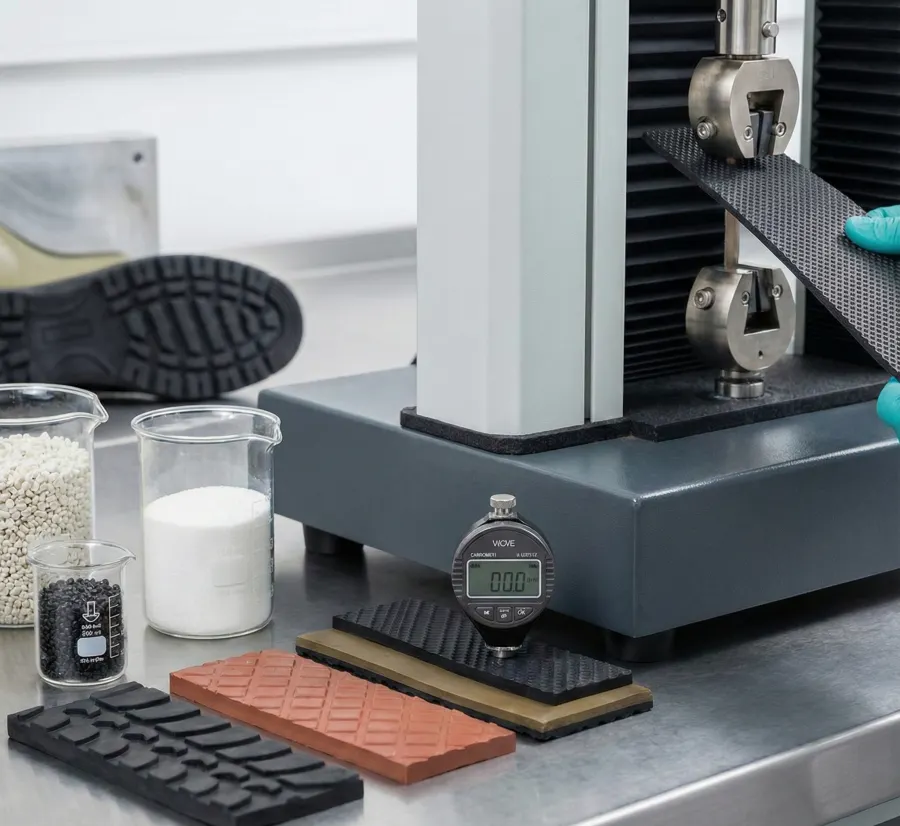
Every rubber sole starts as a recipe. The recipe decides hardness, grip, abrasion resistance, color, and how the sole ages on the shelf and on the street. Buyers who understand the main ingredients ask sharper questions, read spec sheets with confidence, and spot weak formulations before a bulk order ships. This guide covers the six ingredient groups in a footwear-grade rubber compound and shows you how each one shapes the finished sole.
What Compounding Means
Compounding is the process of blending raw rubber with other ingredients to reach a target set of properties. Raw rubber alone makes a poor sole. The material is sticky, soft, and weak, and the material changes with temperature. Additives turn the raw polymer into a durable, consistent product.
Compounders write each recipe in parts per hundred rubber, shortened to phr. The base polymer counts as 100 parts, and every other ingredient gets a number relative to the polymer. A recipe with 50 phr of filler holds 50 parts of filler for every 100 parts of rubber. Suppliers treat these recipes as proprietary, so you rarely see the exact numbers. You do see the results on the spec sheet.
Ingredient One: The Base Polymer
The base polymer sets the foundation. Footwear compounds draw from a short list.
- Natural rubber offers elasticity and good tensile strength.
- SBR, a styrene butadiene rubber, offers abrasion resistance at a lower cost and appears in many sole compounds.
- Polybutadiene rubber adds abrasion resistance and low temperature flexibility, and compounders often blend polybutadiene with other polymers.
- Nitrile rubber resists oils and fuels, which matters for industrial and safety soles.
- EPDM resists heat, weather, and ozone.
- Neoprene resists oils, weather, and flame better than natural rubber.
- Silicone handles wide temperature swings and suits specialty applications.
Most footwear soles use a blend of two or more polymers, since no single polymer wins on every property. Performa/Tunit sheets take this idea one step further by blending rubber compounds, including EPDM, neoprene, nitrile, silicone, and SBR, with EVA for a lighter result.
For the material background, see What Is Performa Sheet?
Ingredient Two: Fillers
Fillers make up the largest share of a rubber compound by weight after the polymer. Fillers fall into two groups.
Reinforcing fillers raise strength and abrasion resistance. Carbon black does this job in black soles. Silica does the same job in colored and light soles, where black pigment would ruin the color.
Extending fillers, such as calcium carbonate and clay, lower cost and adjust hardness. Too much extending filler weakens the compound, so compounders balance cost against durability.
Filler choice explains a pattern you see in the market. Black outsoles often wear longer than pale outsoles at the same price, since carbon black reinforces rubber strongly. Light-colored and non-marking soles depend on silica and mineral fillers, which cost more to process well.
Ingredient Three: Plasticizers and Process Oils
Plasticizers and oils soften the compound and help the material flow during mixing and molding. A higher oil level gives a softer sole and easier processing. The tradeoff: heavy oil loading reduces abrasion resistance and tensile strength, and poor oil choice leads to surface bloom or staining on light colors.
Oil choice also connects to compliance. Some process oils carry polycyclic aromatic hydrocarbons, and several markets restrict these substances in footwear. Ask your supplier which oil grades the compound uses and which restricted-substance limits the compound meets.
Ingredient Four: The Cure System
Raw rubber becomes a usable sole through vulcanization, a chemical reaction linking polymer chains together. The cure system drives this reaction. Most footwear compounds use sulfur together with accelerators and activators. Zinc oxide and stearic acid serve as the standard activators.
Cure system design controls three things.
- Hardness and elasticity. A higher cross-link density gives a harder, less stretchy sole.
- Cure speed. Faster cures shorten the molding cycle and lower cost.
- Scorch safety. Scorch means the compound starts curing too early, during mixing or storage. A good cure system leaves a safe processing window.
Undercured soles stay soft and wear fast. Overcured soles turn brittle and crack at flex points. This is why cure time and mold temperature records matter during a factory audit.
Ingredient Five: Protective Additives
Antioxidants and antiozonants protect the finished sole against oxygen, ozone, heat, and sunlight. Without protection, rubber hardens, cracks, and loses color over time. Protective additives matter more for soles sold in hot, sunny markets and for pale colors. Some protective additives stain light-colored rubber, so compounders choose non-staining grades for white and bright soles.
Ingredient Six: Pigments and Special Additives
Pigments set color. Compounders match pigments to a color standard, and your buyer sets the tolerance, usually through a Delta E value. Blowing agents create the cellular structure in sponge rubber soles. Other special additives include flame retardants, tackifiers for bonding, and agents giving non-marking or anti-static behavior.
How Formulation Maps to Your Spec Sheet
Use this table to connect a spec sheet number to the formulation lever behind the number.
| Spec Sheet Property | Main Formulation Levers |
|---|---|
| Shore A hardness | Filler level, oil level, cure system |
| Abrasion resistance | Polymer blend, reinforcing filler |
| Oil resistance | Nitrile or neoprene content |
| Weather and ozone resistance | EPDM content, antiozonants |
| Compression set and resilience | Cure system, polymer choice |
| Color and staining | Filler type, pigments, non-staining protectants |
Where Mixing and Milling Fit
The recipe only works if the factory blends the ingredients well. Compounders load the polymer and most additives into an internal mixer, often a Banbury type, and add the curatives last at lower temperature to avoid scorch. A two-roll mill then sheets the compound and finishes the blend. Compression molding cures the compound into the final shape. Poor mixing leaves uneven hardness across a batch, even when the recipe is sound.
Questions to Ask Your Supplier
You do not need the exact recipe. You need evidence the supplier controls the recipe. Ask these questions.
- Which polymer family does the compound use, and does the blend suit my application?
- Which restricted-substance limits does the compound meet, and where are the test reports?
- How do you check hardness across a mixed batch?
- How do you control batch-to-batch color?
- Which protective system covers sunlight and ozone exposure?
- What happens when a batch falls outside spec?
Working With Weston Rubber
Weston Rubber formulates rubber compounds for footwear soling and tests hardness across mixed batches, so your production line sees consistent material from one order to the next. Share your target hardness, color, and application, and our team recommends a polymer and filler approach before you commit to a full order.
Common Compounding Problems and What They Signal
Defects on a finished sole often point back to a specific formulation or mixing issue. Learn the pattern, and you diagnose problems faster.
- Uneven hardness across a batch signals poor dispersion during mixing or a weak batch control process.
- Color streaks signal poor pigment dispersion or contamination from a previous compound.
- Surface bloom, a powdery or oily film, signals ingredients migrating to the surface, often from excess oil or protective additives.
- Cracking at flex points signals overcuring, weak polymer choice, or insufficient protection against ageing.
- Soft, fast-wearing soles signal undercuring or a heavy oil level.
- Staining on pale soles signals a protective additive or filler unsuited to light colors.
Raise these patterns during supplier reviews. A supplier who explains the cause and the corrective action for each shows real control of the formulation and the mixing process.
Frequently Asked Questions
What does phr mean in a rubber formulation?
Phr stands for parts per hundred rubber. The base polymer counts as 100 parts, and every other ingredient gets a number relative to the polymer.
Why do black rubber soles often wear longer than light-colored soles?
Carbon black reinforces rubber strongly. Light soles use silica or mineral fillers to keep the color clean, and these fillers need careful processing to match the same reinforcement.
What is the difference between SBR and natural rubber in a sole?
Natural rubber offers elasticity and tensile strength. SBR offers strong abrasion resistance at lower cost. Many sole compounds blend both.
Which rubber suits oil-exposed footwear?
Nitrile rubber blends resist oils and fuels, which makes nitrile a common choice for safety and industrial soles. Request test data against your required standard.
Why does cure time matter to a buyer?
Undercured soles stay soft and wear fast, while overcured soles turn brittle and crack. Ask for cure time and mold temperature records during a factory audit.